
Felicidades México. MUY BIEN.
Standard
Felicidades a todos los miembros del equipo campeón Mexicano de Futbol en las Olimpiadas 2012. Ponen el nombre de nuestro país en alto y se vuelven en un símbolo deportivo. Son los responsables de que volvamos de la justa olímpica con medalla de oro. Son orgullo mexicano. Muchas gracias.
Mexico is Flunking in Education
StandardHere is a link to my latest article on AQBlog, titled “Mexico is Flunking in Education“, published on July 25th, 2012. Please feel free to visit and comment. Here is a verbatim copy of it in case you prefer to read it on my personal blog, though I recommend actually going to the site because of additional content, other blogger’s articles, etc.
—
On July 22, the Mexican Education Ministry (Secretaría de Educación Pública, or SEP) published the results for the Knowledge, Ability and Teaching Skills National Exam, the annual test the Mexican government uses to award teaching positions in the country. The outcome paints a grim picture for children seeking quality education in Mexico.
A year ago, I wrote about the fact that the test in itself is not exigent enough and that the passing grade is a meager 30 percent. Back then I took a deep dive into the way the test is structured and concluded that it was practically impossible to fail. Well the results are in, and unfortunately, I underestimated the level of ignorance in the people responsible for preparing Mexico’s youth for the challenges of tomorrow. There’s something categorically wrong in Mexico’s education system when out of 134,704 people that took this simple test, over 70 percent don’t get half of it right and only 309 (0.2 percent) get a perfect score.
Of the over 18,000 teaching-position vacancies that will be filled this year, 309 applicants are up to par based on the already low standards SEP was able to negotiate with the National Educational Workers Union (SNTE). The rest of our new teachers present huge deficiencies in curricular content (actual subject matter), scholastic competencies, logic, and/or ethics.
This test was applied in all Mexican states except Michoacán and Oaxaca, where the teacher’s union is controlled by the National Educational Workers Coordinator (CNTE), a group which has opposed teacher evaluations in general and is even more radical than Elba Esther Gordillo’s SNTE. One can only imagine what the outcome of the test would have been in these entities. And if the teachers are flunking out, it doesn’t take a genius to figure out what is happening with the students, which is good, because we apparently don’t have too many of them anyways (geniuses, not students).
Election after election, Mexico has heard the same story. In every race, candidates point to education as a critical issue and yet these promises seldom become more than empty political rhetoric. There are a number of reasons for this:
Amount of money is not the main issue. Contrary to popular belief, the education problem in Mexico has less to do with available federal budget resources and more to do with their allocation. About 5.3 percent of Mexico’s GDP goes to education. That’s more than Canada, Costa Rica and Australia and just under the United States. The problem is that while these countries actually invest in the quality of their teachers and improvements in infrastructure, Mexico’s education budget is funneled through depraved unions and very little actually seeps through to the schools.
There is no short-term incentive for long-term projects. Mexico’s federal projects and plans are created on a six-year window. Without reelection the president has no real reason to invest in a project that will not deliver tangible results during his tenure. The Minister of Education has little hopes for running for president (though Ernesto Zedillo did and won and recently Josefina Vázquez Mota had a run for the position but failed miserably) and even so, they can always blame the unions for the education having stagnated. Conversely, union leaders, which do not change every six years, have clear interests in maintaining control and power so it is in their interest to favor teachers above student development. The less that they have to hold their constituencies accountable for quality in the work, the more likely they are to continue reaping the benefits of leading the unions.
Our education system is based on memorization and not critical thinking. Students are “taught” to memorize dates and events, multiplication tables, etc. but going back to the question of quality in education, Mexico still has a long way to go. Here, the overwhelming role catholic religion plays in our children’s youth does not help at all. Mexico is not breeding thinkers or leaders; we’re raising followers and record players. We cannot keep pouring money into a system that’s broken in its core. A complete revamping of what is taught and how it is taught is needed for the system to evolve.
Myopically, low levels of education serve the political parties’ interests. It’s easier to get votes out of a dumbed-down constituency than a critical one. There is no clearer example of parties’ narrow-minded take on elections than the presidential race Mexico has just completed. Moreover, as long as our national economic projects continue to point toward cheap labor as Mexico’s source of competitive advantage, there is no real incentive to migrate to an economy of knowledge.
Literacy rates are can easily deceive. According to the CIA World Factbook Mexico has a 86.1 percent literacy rate but evidently, knowing how to read and understanding what it is that we are reading is not the same. PISA (Programme for International Student Assessment) places Mexico’s reading comprehension levels second to last among OECD countries. Canada, which spends less of its GDP on education is almost on top of the list, only bested by Finland. It’s clear that having an over 85 percent literacy rate is in itself, nothing to brag about.
What’s the solution?
More important than “what”, “who” is the key to solving the education problem in Mexico. There are at least two specific groups that need to band together in order to pressure the government to deliver on education programs.
Organized civil society has to take a more active role in ensuring that governments are accountable for what they promise. We have to demand more from our elected officials. Hopefully the social mobilization momentum created around the recent elections can be proactively directed toward this endeavor. The second group that needs to take an active role in education is not surprisingly, the private sector. More businesses need to understand that by fostering, promoting and supporting better education programs, they are investing in more wealth creation capabilities in their consumers and thus, more business. It just makes sense for big business to partner with civil society and government in implementing effective education programs which will give them return on investment in the long run.
Have goals. It’s important.
Standard
Leave your legacy!
StandardDedicated to all of us who are working hard each day to leave our legacy.
Thanks to @asanvicente for sharing this video.
Seven lessons from Mexico’s electoral process
StandardHere is a link to my latest article on AQBlog, titled “Seven lessons from Mexico’s electoral process“, published on July 2nd, 2012. Please feel free to visit and comment. Here is a verbatim copy of it in case you prefer to read it on my personal blog, though I recommend actually going to the site because of additional content, other blogger’s articles, etc.
—
With an estimate of around 37 percent of the votes, Enrique Peña Nieto’s victory in Mexico’s presidential race will be analyzed from multiple angles, including what this will mean with regard to the war on drugs, the economic model in place, relations with the U.S. and the rest of the world, and many other topics.
For the most part, Peña Nieto’s tenure will not imply radical changes in Mexico, for better or worse but the return of the Partido Revolucionario Institucional (Institutional Revolutionary Party—PRI) to power does say a lot about the way Mexico’s society thinks and operates. This electoral process has opened up an interesting window into the Mexican collective psyche. These are some of the lessons from the 2012 election.
Debates are not yet a vehicle for voter decision in Mexico. There were three presidential debates (two official ones and one organized by #YoSoy132 to which Peña Nieto did not attend) during the presidential race. Peña Nieto’s participation in these dialogues was considered lukewarm at best. His rhetoric was empty but his poor performance was not enough to shift voter preference away from him and toward a second viable option.
We still have a long way to go to build political awareness and education. Peña Nieto’s success cannot be attributed to a strong and enriched political platform or to his superiority as a candidate over his competitors. One could not say that he is smarter, better prepared or better equipped to be president than his competitors. Peña Nieto’s success shows that Mexican voters can easily be manipulated (or convinced) through robust campaigning, a large TV presence and looks. As different media showed when they interviewed people at political rallies (for the three major candidates), a large quantity of voters had no idea of where candidates stood on relevant issues. “I trust him,” “He’s cute” and “I’ll vote for him because the other one is crazy” were some of the compelling arguments that gave Peña Nieto a victory on July 1. Sadly, we still have a long way to go to create an informed voter base. The candidate you saw more billboards and TV ads from, is the one that came out on top in voter preference.
Short-term memory plays a more important role than long-term memory. Peña Nieto won for many reasons but one of them was definitely that voters wanted to punish the Partido Acción Nacional (National Action Party—PAN) for its performance in the past 12 years and Andrés Manuel López Obrador (AMLO) for his lack of respect for the rule of law during his 2006 post-election shenanigans. Mexico was willing to forgive and forget and make peace with the PRI because as many voters put it “we were better off with PRI,” for the most part referring to the increasing levels of organized crime violence resulting from the active war on drugs set forth by President Calderón.
There is e-Mexico and then there’s Mexico. There is a clear divide among Mexicans with access to social networks and those without. On Twitter, users were appalled with the results. Even when all polls signaled Peña Nieto’s victory, Internet users were not willing to believe them. Conversations on Twitter and Facebook had been significantly dominated by AMLO and Josefina Vázquez Mota (PAN) followers. A popular tweet on the night of the election was “I have no idea how they did it. Does anybody here know anyone who voted PRI?” For the most part, the answer was no. Peña Nieto was elected for the most part, by people who do not actively participate online. For upcoming elections, candidates should know that the segment of Internet users in Mexico will only become larger and they will need to actively engage them during the campaign.
The return of PRI does not mean the return of absolutism. This is not optimism; it’s just a very likely reality. Pessimists are evaluating the return of the PRI as a step back in our democracy because they remember the 70 years of absolutism; instead, it is yet another building block in our system which will put to the test whether or not we are a mature enough society to deal with altering power. The PRI will rule a very different Mexico from in the past. Civil society will be more vigilant and we will hold Peña Nieto accountable for his performance as president. Technology will play a significant role in maintaining a non-official discourse, with freedom of speech and free flow of information empowering a growing sector of society. Even with a party majority in Congress, Peña Nieto will have to answer to Mexicans who will either reward or punish his party in future elections.
PRI holding both the executive and a majority in Congress will be an acid test on government efficiency. Both Vicente Fox and Felipe Calderón of the PAN had a very good excuse when their effectiveness was questioned. They could just say (and many times they would have been right) that Congress was blocking their ability to operate and put forth structural reforms. Peña Nieto will have no such excuse with a PRI majority Congress to not pass and implement the labor, energy, security and political reforms that society has demanded and that have been paralyzed by a non-cooperative legislature during the Calderón government. This will also lead us to question if Mexico’s democracy could actually work and be effective if a real system of checks and balances is in place.
Most people did not vote for Peña Nieto. There were more votes against Peña Nieto than in favor of him. Just like Calderón, Peña Nieto will preside over a country that for the most part, did not want him to be president and did not choose him. This is why last night he went on national TV to say that we should “set aside our differences and privilege our common goals […] we may have different preferences but we have something that binds us together: our love for Mexico […] we share the same challenges and must work together to overcome them.” While his inclusive rhetoric is exactly what Mexico needed to hear last night as it attempts to move forward from electoral campaigning divides, the fact of the matter is that winning by a relative majority surfaces yet again the need to implement a run-off electoral process, just like Calderón proposed to Congress (and was blocked). Given the results of last night’s election, would Peña Nieto have won in a second round of elections running only against López Obrador?
Interesting analysis of the three main presidential candidates in Mexico, by Denise Dresser
StandardA worthwhile lecture from Denise Dresser profiling the three main presidential candidates in Mexico.
Thanks to Xipactli who shared this link with me.
The Path of #YoSoy132
StandardHere is a link to my latest article on AQBlog, titled “The Path of #YoSoy132“, published on June. 27th, 2012. Please feel free to visit and comment. Here is a verbatim copy of it in case you prefer to read it on my personal blog, though I recommend actually going to the site because of additional content, other blogger’s articles, etc.
—
#YoSoy132 has been called many things: “the voice of a new generation;” “the Mexican Spring;” and “young people manipulated by the PRD [Partido de la Revolución Democrática, or Party of the Democratic Revolution]” are just a few. Whatever its true nature, this youth movement has left a new mark on electoral processes in Mexico—one which could shape not only the outcome but the aftermath of the 2012 Mexican elections next Sunday.
It all began on May 11 when Enrique Peña Nieto, presidential candidate of the Partido Revolucionario Institucional (Institutional Revolutionary Party—PRI), belittled a group of student protesters that had gathered at the Universidad Iberoamericana to repudiate his presence there. Peña Nieto called them a small group of rabble-rousers, accused them of not being actual students and minimized their protest to opposition made up of only 131 people.
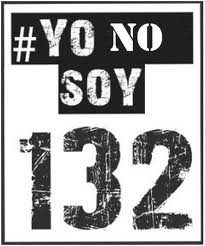 This led to the students uploading a YouTube video showing their university IDs and claiming that their cause was shared by many more young people. The video went viral and the story spiraled into Twitter via the hashtag #YoSoy132 (“I Am 132”). Without a cohesive agenda or clarity with regards to what “being 132” really meant, people sympathized with the students and began retweeting that they too were 132.
A series of strange events followed, making the nature of the movement even less clear and more confusing. Initially, it seemed that the movement’s sole purpose was to demand objective coverage from the largest television news outlet in the country, which allegedly has given favorable coverage to Peña Nieto’s candidacy. However, allegiance to PRD presidential candidate Andrés Manuel López Obrador (AMLO) from some of the movement’s leaders despite being a nonpartisan movement, an inconsistent rhetoric of formally campaigning against Peña Nieto while calling for media objectivity, and conflicting messages from its members have left most Mexicans wondering what it actually means to state that Yo Soy 132.
Students attempted to organize; they took to the streets and demanded that the second presidential debate be broadcast over the main TV channels; they held an assembly in order to look for an aligned, common vision. Judging from their concluding declaration and the following fallout of rogue mini-groups, they failed at this objective—but the movement continued to grow in a somewhat chaotic manner. #YoSoy132 was even able to hold a presidential debate on June 19 with an innovative format and the use of internet to connect different students from their homes to pitch questions to candidates. Playing it safe, Peña Nieto declined the invitation to participate.
Recently, the hacktivist group Anonymous, through its Mexico branch, published a video which calls out the federal electoral authority—Institudo Federal Electoral (IFE)—of apparent intention to manipulate the final voting tally in favor of Peña Nieto.
The “preparation for fraud” discourse has been heightened not only by Anonymous, but coincidentally by #YoSoy132 and by AMLO himself. While #YoSoy132 has been threatening that “Si hay imposición habrá revolución” (if there is imposition there will be a revolution), López Obrador has stated that he knows that the PRI is preparing a fraud but his team will be more vigilant to prevent it, similar to his accusations six years ago when he was the presidential runner-up to Felipe Calderón. To make matters more worrisome, the Ejército Popular Revolucionario (Popular Revolutionary Army—EPR) guerrilla group has recently applauded #YoSoy132 and stated that they would take AMLO at his word and support taking arms in order to avoid “a neoliberal candidate” seizing power.
For the sake of any functional democratic state, electoral fraud must be avoided. A system of checks and balances which is actually built in to the Mexican democratic system—including observers and scrutinizers, exit polls, citizen participation in the actual vote counting, and other mechanisms—seems to be insufficient. And while one should not be disingenuous and think that that these mechanisms fully prevent fraudulent practices from taking place from any candidate, a bigger danger is now present: What if #YoSoy132, Anonymous, EPR and others simply don’t like the outcome of the election because their choice did not come out on top, fraud or no fraud? What if Peña Nieto actually and fairly wins but AMLO, as in 2006, does not recognize defeat?
In the first weeks of #YoSoy132 emerging, people started comparing the movement to the Arab Spring and specifically the Egyptian deposition of Hosni Mubarak. While there is simply no comparison between the Mubarak regime and Mexico’s current political and institutional reality, there is one thing in common: Whenever a grassroots movement with no clear agenda, vision, values, or follow-through plan is able to cluster different groups together in order to eliminate or threaten a common enemy, it may be effective in damaging or removing the unwanted player from the mix—but dangerously ineffective in providing a long-term outcome which benefits all those who pulled together. Given the current state of Egypt, Mexicans should learn from this example.
Today, apparently #YoSoy132 means “I don’t want Peña Nieto to win”—but for different reasons. Some support the group because they feel traditional media should not be biased. Others like it because they want AMLO to be the next president. A few think that they support Josefina Vázquez Mota, candidate of the incumbent Partido Acción Nacional (National Action Party—PAN) by saying they are 132. Anonymous seems to want the IFE to be impartial and EPR says that being 132 means taking arms and not supporting the world’s predominant economic model. Some consider being 132 good and active citizenship; others a call to arms against the establishment.
While I applaud the awakened spirit of youth taking a more active role in this election and hope this will mean a larger young voter turnout than what was projected prior to the movement, as long as there is no consensus about what being 132 means, Yo No Soy 132 and I hope for avoidance of post-electoral violence, no matter who Mexico elects as its president this Sunday.
En nuestro México…
StandardAyer lo vi en el cine… neta me sacó una lágrima. Te quiero, México.
Vota Pensando
StandardLas elecciones están a la vuelta de la esquina y hoy amanecí reflexionando sobre la importancia del voto razonado. Inmediatamente empecé a twittear en breves líneas algunos pensamientos que quisiera compartirles a manera compilada en este blog post. Ojalá sea de su interés:
Si este domingo basas tu decisión en encuestas y razonamiento de “voto útil” demuestras falta de ideales y resolución propia. #VotaPensando
Si tu voto este domingo lo define una encuesta, otros decidieron tu voluntad. #VotaPensando
Si tu voto no es a favor de un candidato sino en contra de otro, decides perder una oportunidad de expresar convicción real #VotaPensando
Si no te informaste realmente antes de ir a las casillas, tu voto lo define una campaña de mercadotecnia #VotaPensando
Si te “informaste” para votar leyendo tuiteros comprados (de cualquiera de los partidos) eres reflejo de la ignorancia #VotaPensando
Si un video de YouTube hecho en WindowsMovieMaker y plagado de faltas de ortografía y calumnia define tu voto, no mames. #VotaPensando
Si un hashtag de 5 letras y 3 números define tu voto, que fácil es manipular tus ideas. #VotaPensando
Si votas en base a lo que otros dirán/pensarán de ti, te recuerdo que el voto es secreto #VotaPensando
Si razonas tu voto en base a evitar un conflicto postelectoral, el conflicto lo tienes contigo y con tu falta de idea política #VotaPensando
Hay 5 opciones de cómo votar el 1ero de julio para Presidente, todas con sus implicantes. #VotaPensando y asume la resposabilidad de decidir
Si te crees el cuento de que una televisora tiene el poder de definir tu voluntad, te recuerdo que el que vota eres tú. #VotaPensando
Tengo mucho más que decir al respecto y estoy seguro que ustedes también. Independientemente del candidato o candidata, creo que vale la pena que quienes tenemos acceso a información y capacidad de discernir, lo hagamos. De esta manera podremos dormir tranquilos el 1ero de julio después de haber ejercido nuestro derecho y obligación de votar.
Viva México y quienes lo queremos.
 ArjanShahani.com