Mexico’s Supreme Court Ruling a Step Toward Greater Tolerance

Standard

Here is a link to my latest article on AQBlog, titled “Mexico’s Supreme Court Ruling a Step Toward Greater Tolerance“, published on March 8th, 2013. Please feel free to visit and comment. Here is a verbatim copy of it in case you prefer to read it on my personal blog, though I recommend actually going to the site because of additional content, other blogger’s articles, etc.

If there is one thing Mexico’s men are famous for, it is the celebration of being macho. We see this everywhere: In telenovelas, the butch and handsome male protagonist becomes the hero only after he conquers the lovely señorita by wooing her with his macho chivalry. It is common to hear traditional male fathers telling their sons “real men don’t cry.”

A number of consumer products also cater to this very innate part of the Mexican heterosexual male’s existence through marketing, which might be considered as sexist in other cultures. The macho element also permeates humor; viewed through the optics of U.S. culture it no doubt be deemed much more than politically incorrect. This is not a matter of right or wrong, but rather a plain and simple recognition of who we are as a culture today.

On March 6, however, Mexico’s Supreme Court of Justice (SCJN) took a decision that could lead to a shift in the way Mexican machos coexist with homosexuality, which today is regularly mocked. Mexican insults such as “maricón” or “puñal” (derogatory terms for “gay male”) are thrown around in colloquial talk with as much disdain as the word “pansy” in the English language. But the Supreme Court decided that such expressions are not protected by freedom of speech and can be subject to lawsuit on the basis of moral harm.

The split 3-2 judicial decision is probably an accurate proportion of how Mexican society would view the subject. Some view this as a step toward inclusion and tolerance. Others see this as unnecessary ruling and censorship of what has traditionally been acceptable humor.

The approved ruling states that “Homophobic expressions, that is, language consistent in inferring that homosexuality is not a valid option, but rather a condition of inferiority, constitute discriminatory manifestations. This includes the use of such terms in humorous use, given that through them, intolerance toward homosexuality is incited, promoted and justified.” The ruling goes on to acknowledge that these expressions are part of common use in Mexico’s culture by stating that, “while these expressions are strongly embedded in Mexican society’s language, practices by the majority of a population cannot validate violations to fundamental rights.”

As with most countries and cultures, gender diversity is slowly but surely (granted, more slowly than us progressive thinkers would like) moving forward.

The antigay sentiments and comments common in previous generations are less present with youth today, even if the male macho is still a predominant figure in our culture. But the SCJN’s ruling, if harnessed correctly, can be a powerful boost toward a more open and tolerant society. If really enforced, this ruling could create a huge shift in approved TV content for example, which is a powerful vehicle in our culture. Today, many humor programs make fun of LGBT individuals by portraying them as inferior and/or exaggerating stereotypical effeminate traits, thus teaching that these expressions are acceptable in society. With the ruling, this type of humor could hold TV companies liable and perhaps motivate them to change their content. In an ideal scenario, this would extend to TV companies that shield themselves from responsibility by stating, “we give people what they want to see.”

While enforceability of this ruling in everyday social interaction and situations proves complicated, the institutionalization of hate humor in printed media and television can be affected. This is, in a way, something similar to the shift made with regard to cultural acceptance of smoking. When did smoking stop being cool? Many would say it was when we stopped seeing it as acceptable in TV and later in social occasions. Even if it takes a couple of generations to accept, typifying homophobic slurs as hate speech is a celebratory step toward social inclusion and tolerance in Mexican culture.

*Arjan Shahani is a contributing blogger to AQ Online. He lives in Monterrey, Mexico, and is an MBA graduate from Thunderbird University and Tecnológico de Monterrey and a member of the International Advisory Board of Global Majority—an international non-profit organization dedicated to the promotion of non-violent conflict resolution.


A Window of Opportunity for Education in Mexico

Standard

Here is a link to my latest article on AQBlog, titled “A Window of Opportunity for Education in Mexico“, published on February 27th, 2013. Please feel free to visit and comment. Here is a verbatim copy of it in case you prefer to read it on my personal blog, though I recommend actually going to the site because of additional content, other blogger’s articles, etc.

On Monday February 25, having achieved the needed support in Congress, President Enrique Peña Nieto put into effect an education reform that will transform the public education system at its core. If enacted correctly, the reform will allow the country to take important steps forward and proactively tackle one of its most relevant social issues.

The reform calls for a new autonomous government institute to be created, with the sole purpose of strengthening and professionalizing the teaching profession by establishing a talent performance system that will ensure that teaching positions are awarded based on merit and not discretional criteria. The system includes periodical evaluations for the public system teachers, a change that undoubtedly will generate resistance from teachers who have become quite comfortable in mediocrity under the protection of a backwards thinking union that is too strong and powerful for its own good.

The new institute will also be responsible for ensuring that a trustworthy database comprising numbers of schools, teachers and students is created and kept up to date. This administrative responsibility also used to be in the hands of the SNTE (Sindicato Nacional de Trabajadores de la Educación), who kept whatever data they had away from public scrutiny.

In what can only be interpreted as a strategy to hit them while their down, one day after Peña Nieto published the reform, the country was surprised with the arrest of SNTE’s controversial and powerful leader, Elba Esther Gordillo who is facing charges for fraud, money laundering and links to organized crime.

The case being built up by the Public Attorney’s office (PGR) highlights accusations of SNTE’s money being used to pay for purchases made by Gordillo from 2009 to 2012 in the upscale store Neiman Marcus, amounting to up to $3 million. This is not the first time questionable purchases have been made with SNTE’s money but it is the first time the government has moved against the union’s leader so decisively and surely, the only way they were going to be able to get rid of this influential character, whose position as leader of the union did not have an expiration date on it.

With the new educational reform put in place and the largest obstacle for its success removed and (at least temporarily) placed in a jail cell, the future for education in Mexico seems bright as it does for PRI and Peña Nieto, who up to now has not been able to gain public sympathy or project himself as having the capabilities to lead. If Peña continues on this path and ensures that the reform results in actions with tangible results for society, PRI will have taken a huge step toward rebuilding its political machinery and consolidating its power both at state and federal levels in future elections.

If that’s what it takes to start making much needed improvements in Mexico’s education, the nation will surely welcome the return of PRI’s perfect dictatorship. Let’s hope the trade-offs (because no question, there will be major ones) are worth it.

*Arjan Shahani is a contributing blogger to AQ Online. He lives in Monterrey, Mexico, and is an MBA graduate from Thunderbird University and Tecnológico de Monterrey and a member of the International Advisory Board of Global Majority—an international non-profit organization dedicated to the promotion of non-violent conflict resolution.
Monterrey, Mexico: Living amid the Rule of Fear

Standard

Here is a link to my latest article on AQBlog, titled “Monterrey, Mexico: Living amid the Rule of Fear“, published on December 10th, 2012. Please feel free to visit and comment. Here is a verbatim copy of it in case you prefer to read it on my personal blog, though I recommend actually going to the site because of additional content, other blogger’s articles, etc.

For the past couple of years, people from all over the world have been asking me the same question: how bad are things in Monterrey, really? Obviously, they are referring to the drug-related violence and overall instability that have recently given the city unwanted international attention.

There’s a saying in Mexico: “cada quién cuenta como le fue en la feria, which roughly translates to “how the tale is told depends on what the narrator has been through.” Therefore, my experience will not resonate equally among some others who live in Monterrey, but I do hope it will provide a relatively objective conclusion and answer to the above question.

Since the underlying interest behind the question is learning more about the situation of violence, I will not get into details about how Monterrey has a buoyant economy, entrepreneurial society, growing industrial sector, or is the birthplace of the most important higher education systems in Latin America and the home of hard-working, committed individuals. What I will focus on is how daily life has changed for middle-class citizens as a result of the violence and how societal interaction today is less regulated by a rule of law and more so by a rule of fear.

For the most part, people are still able to go to work, attend restaurants, movie theaters and parks and lead normal lives. But a certain fear has now been engrained into the average regiomontano’s DNA and it has changed how we go about our daily activities:

  • Public places: There are certain restaurants and bars we don’t go to anymore. In fact, a whole area of the city known as Barrio Antiguo, which used to be the cultural, culinary and entertainment center of Monterrey, is practically abandoned now. Close to Barrio Antiguo, young male adults who used to flock to mens’ clubs and after hours bars late at night are doing this less and less because they fear these establishments to be controlled by the cartels and gangs. If a neighborhood is dangerous—or, more importantly, if it is perceived as such—then we simply avoid it. A lot of the nightlife has migrated and concentrated into San Pedro Garza García, the safest and highest income per-capita municipality in the metropolitan area.
  • Get-togethers: You still go out and see your friends. Nightlife is not dead, but there is an undeniable shift toward home get-togethers versus going to night clubs. People try to hang out with people they know and get away from those they don’t know. This can easily be measured by the changes in the sales of alcohol in supermarkets and retail stores in comparison to restaurants and nightclubs. Also, regiomontanos are turning in a lot earlier than they used to and on weekend nights, what used to be bumper to bumper traffic in the main streets of the city is replaced by the few brave enough to speed through on their way home.
  • Talking about it: The topic of insecurity, discussing drug cartels or even mentioning certain names, has become taboo in many public spaces because “you never know if one of these criminals or someone linked to them is sitting at the table next to you.” Just based on probability, the likelihood of this happening would be considerably low, but people prefer to just play at safe. It’s a really interesting phenomenon to see how when people are going to discuss the subject in public, they always look around and lower their voices first or just wait to be in a private space.
  • Going to school: When middle- and upper-class parents choose the private grade school for their children, the new variable of fear is brought to the table. A couple of the top grade schools in the Monterrey area have excellent curricula, staff, technology, and campuses but they are located in the Santa Catarina municipality and the roads that go to these schools go through some of the crime hot spots. Thus, parents’ choice for quality in education is being put in the balance against peace of mind and security.
  • Driving with others: Ironically, regiomontanos have become more polite behind the wheel of a car. Excessive honking has been replaced by an almost eerie silence in many of our streets. Most people have shifted toward using the horn only to avoid imminent accidents because “you never know if the guy who cut into you is a criminal or somebody linked to the drug cartels and you don’t want to draw attention to yourself.” People still cut each other off and they still turn left from the right lane. We’re still immensely bad drivers; we just don’t honk, yell and swear at each other for it anymore.

From reading some of these changes in daily lives, one could conclude that people who would not traditionally be considered criminals—the common folk—are actually behaving better than in the past. They are risking harm to themselves less. While that may be the case, the reason for it is rather unfortunate: it’s not that we abide by or respect a rule of law; we are restricted in our liberties because of a rule of fear.

Official sources reported that November presented a significant decrease in executions, house break-in and car theft but that has had little to no effect in society’s perception of the risks they may face in the city they live in.

So what is it like to live in Monterrey, really? The city continues to have several positive and unique aspects to it. But what has changed? We are not caught between crossfire, held at gunpoint or witness beheadings on a daily basis, but the difference from years back is that now is the presence of fear for these things actually happening and our conduct adapting accordingly.

Hopefully, we will be able to eliminate this fear in the near future, through projects and day to day actions which eliminate the reasons for our fear strengthen a culture of lawfulness, reclaim public spaces and harness the strength of an active and organized civil society and a committed private and public sector.

Censorship in Mexico: The Case of Ruy Salgado

Standard

Here is a link to my latest article on AQBlog, titled “Censorship in Mexico: The Case of Ruy Salgado“, published on October 29th, 2012. Please feel free to visit and comment. Here is a verbatim copy of it in case you prefer to read it on my personal blog, though I recommend actually going to the site because of additional content, other blogger’s articles, etc.

Most people outside of Mexico may have never heard of Ruy Salgado. But during the most recent electoral contest here, that name not only became known throughout Internet circles in Mexico, but was arguably one of the most influential voices of opposition in the country.

Ruy Salgado, a pseudonym, has an online alias known as el 5anto. Salgado is a nonprofit video blogger whose notoriety increased during these past elections for his very critical view of both the transparency of the process and the role of the mainstream media in “manipulating the truth.” He was also one of the most vocal in denouncing what he referred to as institutionalized fraud in the results that will bring the Partido Revolucionario Institucional (Institutional Revolutionary Party—PRI) back to power on December 1.

El 5anto’s modus operandi was to webcast himself live, wearing a blue luchador mask, providing news and opinion rarely present in mainstream media. This approach was part commercial flair, part self-protection. During the time his project was online, he attracted a growing audience whose members may not have all supported his beliefs, but who did attest to the professional way in which they are always presented: stating sources, structuring analyses and providing informed and argumentative opinion.

For his views and his attempts to “provide information”—always his prime objective—el 5anto became a target of multiple death threats. At one point he even fled the country and started streaming from an undisclosed location for fear of becoming yet another communicator permanently silenced by those who have made journalism an extremely dangerous profession in Mexico.

On September 8, people who would regularly tune in to Salgado’s website, http://el5antuario.org, were suddenly cut off from the feed and his video-blog (“vlog”) channel went silent. After a couple of days without news, collaborators from his site issued a recording stating that their spokesperson had disappeared and they lost contact with him. For more than a month both his collaborators and his audiences feared the worst. While most mainstream media initially ignored the case, the buzz of social media proved too powerful as the words “Where is Ruy Salgado?” became a trending topic on Twitter—leading some television networks, politicians and pundits to finally pay attention. Despite the demands, for more than a month there was nothing but silence from Salgado.

Finally on October 20, through a Skype connection with one of his now-former collaborators who livestreamed the call, el 5anto’s voice was once again heard over the Internet. Unfortunately this would be Ruy Salgado’s last broadcast and final goodbye. In a three-hour message, he explained that he could not go into detail about his victimization during the 42 days of silence “because there is no security that what happened to me will not happen again and I cannot put my family at risk” but he did refer to a “forced disappearance” caused by Mexico being “a failed narco-state.” He went on to reiterate that the free flow of information in spite of attempts from mainstream media to manipulate it, had not been enough to prevent an electoral fraud and that “Mexico will need a lot more than what el5antuario was able to do.”

The objective of his final message, he said, was to tell everybody that he was still alive but that he had decided to cease and desist in his civil disobedience broadcasting because he felt he could no longer provide a voice to el5antuario without putting his family in danger. In this decision el 5anto called himself “a repugnant coward” and asked others video-bloggers “to be very careful.”

The content of Salgado’s final broadcast is honest and factual; his case is yet another grave example of the censorship of free speech and free ideas through violence in Mexico. In sum, the good news is that Ruy Salgado is alive and the bad news is even through anonymity divergent ideas are not safe in today’s Mexico. This country is certainly far off from the idyllic words of  Voltaire: “I disagree with what you say, but I will defend to the death your right to say it.”

Stop cyber-bullying and teach your kids about the risk of sexting

Standard

Kids are gullible. They make mistakes. Make sure you warn your kids. Prevent them so that  horrible cases like Amanda Todd’s do not happen again. RIP Amanda.

Yesterday I learned about a young girl in my hometown (Monterrey) who recently stripped for her boyfriend who videorecorded her… Of course, the video is all over the web, as is another video showing her yelling at the guy for spreading it. This is yet another case of cyber-bullying which will not go away.

Take action. Care for your own. And teach your children about this problem so that they are neither victims nor instigators of cyber-bullying.


Mexico is Flunking in Education

Standard

Here is a link to my latest article on AQBlog, titled “Mexico is Flunking in Education“, published on July 25th, 2012. Please feel free to visit and comment. Here is a verbatim copy of it in case you prefer to read it on my personal blog, though I recommend actually going to the site because of additional content, other blogger’s articles, etc.

On July 22, the Mexican Education Ministry (Secretaría de Educación Pública, or SEP) published the results for the Knowledge, Ability and Teaching Skills National Exam, the annual test the Mexican government uses to award teaching positions in the country. The outcome paints a grim picture for children seeking quality education in Mexico.

A year ago, I wrote about the fact that the test in itself is not exigent enough and that the passing grade is a meager 30 percent. Back then I took a deep dive into the way the test is structured and concluded that it was practically impossible to fail. Well the results are in, and unfortunately, I underestimated the level of ignorance in the people responsible for preparing Mexico’s youth for the challenges of tomorrow. There’s something categorically wrong in Mexico’s education system when out of 134,704 people that took this simple test, over 70 percent don’t get half of it right and only 309 (0.2 percent) get a perfect score.

Of the over 18,000 teaching-position vacancies that will be filled this year, 309 applicants are up to par based on the already low standards SEP was able to negotiate with the National Educational Workers Union (SNTE). The rest of our new teachers present huge deficiencies in curricular content (actual subject matter), scholastic competencies, logic, and/or ethics.

This test was applied in all Mexican states except Michoacán and Oaxaca, where the teacher’s union is controlled by the National Educational Workers Coordinator (CNTE), a group which has opposed teacher evaluations in general and is even more radical than Elba Esther Gordillo’s SNTE. One can only imagine what the outcome of the test would have been in these entities. And if the teachers are flunking out, it doesn’t take a genius to figure out what is happening with the students, which is good, because we apparently don’t have too many of them anyways (geniuses, not students).

Election after election, Mexico has heard the same story. In every race, candidates point to education as a critical issue and yet these promises seldom become more than empty political rhetoric. There are a number of reasons for this:

Amount of money is not the main issue. Contrary to popular belief, the education problem in Mexico has less to do with available federal budget resources and more to do with their allocation. About 5.3 percent of Mexico’s GDP goes to education. That’s more than Canada, Costa Rica and Australia and just under the United States. The problem is that while these countries actually invest in the quality of their teachers and improvements in infrastructure, Mexico’s education budget is funneled through depraved unions and very little actually seeps through to the schools.

There is no short-term incentive for long-term projects. Mexico’s federal projects and plans are created on a six-year window. Without reelection the president has no real reason to invest in a project that will not deliver tangible results during his tenure. The Minister of Education has little hopes for running for president (though Ernesto Zedillo did and won and recently Josefina Vázquez Mota had a run for the position but failed miserably) and even so, they can always blame the unions for the education having stagnated. Conversely, union leaders, which do not change every six years, have clear interests in maintaining control and power so it is in their interest to favor teachers above student development. The less that they have to hold their constituencies accountable for quality in the work, the more likely they are to continue reaping the benefits of leading the unions.

Our education system is based on memorization and not critical thinking. Students are “taught” to memorize dates and events, multiplication tables, etc. but going back to the question of quality in education, Mexico still has a long way to go. Here, the overwhelming role catholic religion plays in our children’s youth does not help at all. Mexico is not breeding thinkers or leaders; we’re raising followers and record players. We cannot keep pouring money into a system that’s broken in its core. A complete revamping of what is taught and how it is taught is needed for the system to evolve.

Myopically, low levels of education serve the political parties’ interests. It’s easier to get votes out of a dumbed-down constituency than a critical one. There is no clearer example of parties’ narrow-minded take on elections than the presidential race Mexico has just completed. Moreover, as long as our national economic projects continue to point toward cheap labor as Mexico’s source of competitive advantage, there is no real incentive to migrate to an economy of knowledge.

Literacy rates are can easily deceive. According to the CIA World Factbook Mexico has a 86.1 percent literacy rate but evidently, knowing how to read and understanding what it is that we are reading is not the same. PISA (Programme for International Student Assessment) places Mexico’s reading comprehension levels second to last among OECD countries. Canada, which spends less of its GDP on education is almost on top of the list, only bested by Finland. It’s clear that having an over 85 percent literacy rate is in itself, nothing to brag about.

What’s the solution?

More important than “what”, “who” is the key to solving the education problem in Mexico. There are at least two specific groups that need to band together in order to pressure the government to deliver on education programs.

Organized civil society has to take a more active role in ensuring that governments are accountable for what they promise. We have to demand more from our elected officials. Hopefully the social mobilization momentum created around the recent elections can be proactively directed toward this endeavor. The second group that needs to take an active role in education is not surprisingly, the private sector. More businesses need to understand that by fostering, promoting and supporting better education programs, they are investing in more wealth creation capabilities in their consumers and thus, more business. It just makes sense for big business to partner with civil society and government in implementing effective education programs which will give them return on investment in the long run.

Seven lessons from Mexico’s electoral process

Standard

Here is a link to my latest article on AQBlog, titled “Seven lessons from Mexico’s electoral process“, published on July 2nd, 2012. Please feel free to visit and comment. Here is a verbatim copy of it in case you prefer to read it on my personal blog, though I recommend actually going to the site because of additional content, other blogger’s articles, etc.

With an estimate of around 37 percent of the votes, Enrique Peña Nieto’s victory in Mexico’s presidential race will be analyzed from multiple angles, including what this will mean with regard to the war on drugs, the economic model in place, relations with the U.S. and the rest of the world, and many other topics.

For the most part, Peña Nieto’s tenure will not imply radical changes in Mexico, for better or worse but the return of the Partido Revolucionario Institucional (Institutional Revolutionary Party—PRI) to power does say a lot about the way Mexico’s society thinks and operates. This electoral process has opened up an interesting window into the Mexican collective psyche. These are some of the lessons from the 2012 election.

Debates are not yet a vehicle for voter decision in Mexico.  There were three presidential debates (two official ones and one organized by #YoSoy132 to which Peña Nieto did not attend) during the presidential race. Peña Nieto’s participation in these dialogues was considered lukewarm at best. His rhetoric was empty but his poor performance was not enough to shift voter preference away from him and toward a second viable option.

We still have a long way to go to build political awareness and education. Peña Nieto’s success cannot be attributed to a strong and enriched political platform or to his superiority as a candidate over his competitors. One could not say that he is smarter, better prepared or better equipped to be president than his competitors. Peña Nieto’s success shows that Mexican voters can easily be manipulated (or convinced) through robust campaigning, a large TV presence and looks. As different media showed when they interviewed people at political rallies (for the three major candidates), a large quantity of voters had no idea of where candidates stood on relevant issues. “I trust him,” “He’s cute” and “I’ll vote for him because the other one is crazy” were some of the compelling arguments that gave Peña Nieto a victory on July 1. Sadly, we still have a long way to go to create an informed voter base. The candidate you saw more billboards and TV ads from, is the one that came out on top in voter preference.

Short-term memory plays a more important role than long-term memory. Peña Nieto won for many reasons but one of them was definitely that voters wanted to punish the Partido Acción Nacional (National Action Party—PAN) for its performance in the past 12 years and Andrés Manuel López Obrador (AMLO) for his lack of respect for the rule of law during his 2006 post-election shenanigans. Mexico was willing to forgive and forget and make peace with the PRI because as many voters put it “we were better off with PRI,” for the most part referring to the increasing levels of organized crime violence resulting from the active war on drugs set forth by President Calderón.

There is e-Mexico and then there’s Mexico. There is a clear divide among Mexicans with access to social networks and those without. On Twitter, users were appalled with the results. Even when all polls signaled Peña Nieto’s victory, Internet users were not willing to believe them. Conversations on Twitter and Facebook had been significantly dominated by AMLO and Josefina Vázquez Mota (PAN) followers.  A popular tweet on the night of the election was “I have no idea how they did it. Does anybody here know anyone who voted PRI?” For the most part, the answer was no. Peña Nieto was elected for the most part, by people who do not actively participate online. For upcoming elections, candidates should know that the segment of Internet users in Mexico will only become larger and they will need to actively engage them during the campaign.

The return of PRI does not mean the return of absolutism. This is not optimism; it’s just a very likely reality. Pessimists are evaluating the return of the PRI as a step back in our democracy because they remember the 70 years of absolutism; instead, it is yet another building block in our system which will put to the test whether or not we are a mature enough society to deal with altering power. The PRI will rule a very different Mexico from in the past. Civil society will be more vigilant and we will hold Peña Nieto accountable for his performance as president. Technology will play a significant role in maintaining a non-official discourse, with freedom of speech and free flow of information empowering a growing sector of society. Even with a party majority in Congress, Peña Nieto will have to answer to Mexicans who will either reward or punish his party in future elections.

PRI holding both the executive and a majority in Congress will be an acid test on government efficiency. Both Vicente Fox and Felipe Calderón of the PAN had a very good excuse when their effectiveness was questioned. They could just say (and many times they would have been right) that Congress was blocking their ability to operate and put forth structural reforms.  Peña Nieto will have no such excuse with a PRI majority Congress to not pass and implement the labor, energy, security and political reforms that society has demanded and that have been paralyzed by a non-cooperative legislature during the Calderón government. This will also lead us to question if Mexico’s democracy could actually work and be effective if a real system of checks and balances is in place.

Most people did not vote for Peña Nieto. There were more votes against Peña Nieto than in favor of him. Just like Calderón, Peña Nieto will preside over a country that for the most part, did not want him to be president and did not choose him. This is why last night he went on national TV to say that we should “set aside our differences and privilege our common goals […] we may have different preferences but we have something that binds us together: our love for Mexico […] we share the same challenges and must work together to overcome them.” While his inclusive rhetoric is exactly what Mexico needed to hear last night as it attempts to move forward from electoral campaigning divides, the fact of the matter is that winning by a relative majority surfaces yet again the need to implement a run-off electoral process, just like Calderón proposed to Congress (and was blocked). Given the results of last night’s election, would Peña Nieto have won in a second round of elections running only against López Obrador?

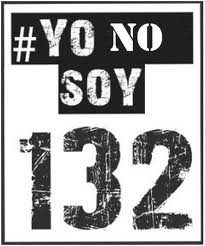
The Path of #YoSoy132

Standard

Here is a link to my latest article on AQBlog, titled “The Path of #YoSoy132“, published on June. 27th, 2012. Please feel free to visit and comment. Here is a verbatim copy of it in case you prefer to read it on my personal blog, though I recommend actually going to the site because of additional content, other blogger’s articles, etc.

#YoSoy132 has been called many things: “the voice of a new generation;” “the Mexican Spring;” and “young people manipulated by the PRD [Partido de la Revolución Democrática, or Party of the Democratic Revolution]” are just a few. Whatever its true nature, this youth movement has left a new mark on electoral processes in Mexico—one which could shape not only the outcome but the aftermath of the 2012 Mexican elections next Sunday.

It all began on May 11 when Enrique Peña Nieto, presidential candidate of the Partido Revolucionario Institucional (Institutional Revolutionary Party—PRI), belittled a group of student protesters that had gathered at the Universidad Iberoamericana to repudiate his presence there. Peña Nieto called them a small group of rabble-rousers, accused them of not being actual students and minimized their protest to opposition made up of only 131 people.

This led to the students uploading a YouTube video showing their university IDs and claiming that their cause was shared by many more young people. The video went viral and the story spiraled into Twitter via the hashtag #YoSoy132 (“I Am 132”). Without a cohesive agenda or clarity with regards to what “being 132” really meant, people sympathized with the students and began retweeting that they too were 132.

A series of strange events followed, making the nature of the movement even less clear and more confusing. Initially, it seemed that the movement’s sole purpose was to demand objective coverage from the largest television news outlet in the country, which allegedly has given favorable coverage to Peña Nieto’s candidacy. However, allegiance to PRD presidential candidate Andrés Manuel López Obrador (AMLO) from some of the movement’s leaders despite being a nonpartisan movement, an inconsistent rhetoric of formally campaigning against Peña Nieto while calling for media objectivity, and conflicting messages from its members have left most Mexicans wondering what it actually means to state that Yo Soy 132

Students attempted to organize; they took to the streets and demanded that the second presidential debate be broadcast over the main TV channels; they held an assembly in order to look for an aligned, common vision. Judging from their concluding declaration and the following fallout of rogue mini-groups, they failed at this objective—but the movement continued to grow in a somewhat chaotic manner. #YoSoy132 was even able to hold a presidential debate on June 19 with an innovative format and the use of internet to connect different students from their homes to pitch questions to candidates. Playing it safe, Peña Nieto declined the invitation to participate.

Recently, the hacktivist group Anonymous, through its Mexico branch, published a video which calls out the federal electoral authority—Institudo Federal Electoral (IFE)—of apparent intention to manipulate the final voting tally in favor of Peña Nieto.

The “preparation for fraud” discourse has been heightened not only by Anonymous, but coincidentally by #YoSoy132 and by AMLO himself. While #YoSoy132 has been threatening that “Si hay imposición habrá revolución” (if there is imposition there will be a revolution), López Obrador has stated that he knows that the PRI is preparing a fraud but his team will be more vigilant to prevent it, similar to his accusations six years ago when he was the presidential runner-up to Felipe Calderón. To make matters more worrisome, the Ejército Popular Revolucionario (Popular Revolutionary Army—EPR) guerrilla group has recently applauded #YoSoy132 and stated that they would take AMLO at his word and support taking arms in order to avoid “a neoliberal candidate” seizing power.

For the sake of any functional democratic state, electoral fraud must be avoided. A system of checks and balances which is actually built in to the Mexican democratic system—including observers and scrutinizers, exit polls, citizen participation in the actual vote counting, and other mechanisms—seems to be insufficient. And while one should not be disingenuous and think that that these mechanisms fully prevent fraudulent practices from taking place from any candidate, a bigger danger is now present: What if #YoSoy132, Anonymous, EPR and others simply don’t like the outcome of the election because their choice did not come out on top, fraud or no fraud? What if Peña Nieto actually and fairly wins but AMLO, as in 2006, does not recognize defeat?

In the first weeks of #YoSoy132 emerging, people started comparing the movement to the Arab Spring and specifically the Egyptian deposition of Hosni Mubarak. While there is simply no comparison between the Mubarak regime and Mexico’s current political and institutional reality, there is one thing in common: Whenever a grassroots movement with no clear agenda, vision, values, or follow-through plan is able to cluster different groups together in order to eliminate or threaten a common enemy, it may be effective in damaging or removing the unwanted player from the mix—but dangerously ineffective in providing a long-term outcome which benefits all those who pulled together. Given the current state of Egypt, Mexicans should learn from this example.

Today, apparently #YoSoy132 means “I don’t want Peña Nieto to win”—but for different reasons. Some support the group because they feel traditional media should not be biased. Others like it because they want AMLO to be the next president. A few think that they support Josefina Vázquez Mota, candidate of the incumbent Partido Acción Nacional (National Action Party—PAN) by saying they are 132. Anonymous seems to want the IFE to be impartial and EPR says that being 132 means taking arms and not supporting the world’s predominant economic model. Some consider being 132 good and active citizenship; others a call to arms against the establishment.

While I applaud the awakened spirit of youth taking a more active role in this election and hope this will mean a larger young voter turnout than what was projected prior to the movement, as long as there is no consensus about what being 132 means, Yo No Soy 132 and I hope for avoidance of post-electoral violence, no matter who Mexico elects as its president this Sunday.

Vota Pensando

Standard

Las elecciones están a la vuelta de la esquina y hoy amanecí reflexionando sobre la importancia del voto razonado. Inmediatamente empecé a twittear en breves líneas algunos pensamientos que quisiera compartirles a manera compilada en este blog post. Ojalá sea de su interés:

Si este domingo basas tu decisión en encuestas y razonamiento de “voto útil” demuestras falta de ideales y resolución propia. #VotaPensando

Si tu voto este domingo lo define una encuesta, otros decidieron tu voluntad. #VotaPensando

Si tu voto no es a favor de un candidato sino en contra de otro, decides perder una oportunidad de expresar convicción real #VotaPensando

Si no te informaste realmente antes de ir a las casillas, tu voto lo define una campaña de mercadotecnia #VotaPensando

Si te “informaste” para votar leyendo tuiteros comprados (de cualquiera de los partidos) eres reflejo de la ignorancia #VotaPensando

Si un video de YouTube hecho en WindowsMovieMaker y plagado de faltas de ortografía y calumnia define tu voto, no mames. #VotaPensando

Si un hashtag de 5 letras y 3 números define tu voto, que fácil es manipular tus ideas. #VotaPensando

Si votas en base a lo que otros dirán/pensarán de ti, te recuerdo que el voto es secreto #VotaPensando

Si razonas tu voto en base a evitar un conflicto postelectoral, el conflicto lo tienes contigo y con tu falta de idea política #VotaPensando

Hay 5 opciones de cómo votar el 1ero de julio para Presidente, todas con sus implicantes. #VotaPensando y asume la resposabilidad de decidir

Si te crees el cuento de que una televisora tiene el poder de definir tu voluntad, te recuerdo que el que vota eres tú. #VotaPensando

Tengo mucho más que decir al respecto y estoy seguro que ustedes también. Independientemente del candidato o candidata, creo que vale la pena que quienes tenemos acceso a información y capacidad de discernir, lo hagamos. De esta manera podremos dormir tranquilos el 1ero de julio después de haber ejercido nuestro derecho y obligación de votar.

Viva México y quienes lo queremos.