Seven lessons from Mexico’s electoral process

Standard

Here is a link to my latest article on AQBlog, titled “Seven lessons from Mexico’s electoral process“, published on July 2nd, 2012. Please feel free to visit and comment. Here is a verbatim copy of it in case you prefer to read it on my personal blog, though I recommend actually going to the site because of additional content, other blogger’s articles, etc.

With an estimate of around 37 percent of the votes, Enrique Peña Nieto’s victory in Mexico’s presidential race will be analyzed from multiple angles, including what this will mean with regard to the war on drugs, the economic model in place, relations with the U.S. and the rest of the world, and many other topics.

For the most part, Peña Nieto’s tenure will not imply radical changes in Mexico, for better or worse but the return of the Partido Revolucionario Institucional (Institutional Revolutionary Party—PRI) to power does say a lot about the way Mexico’s society thinks and operates. This electoral process has opened up an interesting window into the Mexican collective psyche. These are some of the lessons from the 2012 election.

Debates are not yet a vehicle for voter decision in Mexico.  There were three presidential debates (two official ones and one organized by #YoSoy132 to which Peña Nieto did not attend) during the presidential race. Peña Nieto’s participation in these dialogues was considered lukewarm at best. His rhetoric was empty but his poor performance was not enough to shift voter preference away from him and toward a second viable option.

We still have a long way to go to build political awareness and education. Peña Nieto’s success cannot be attributed to a strong and enriched political platform or to his superiority as a candidate over his competitors. One could not say that he is smarter, better prepared or better equipped to be president than his competitors. Peña Nieto’s success shows that Mexican voters can easily be manipulated (or convinced) through robust campaigning, a large TV presence and looks. As different media showed when they interviewed people at political rallies (for the three major candidates), a large quantity of voters had no idea of where candidates stood on relevant issues. “I trust him,” “He’s cute” and “I’ll vote for him because the other one is crazy” were some of the compelling arguments that gave Peña Nieto a victory on July 1. Sadly, we still have a long way to go to create an informed voter base. The candidate you saw more billboards and TV ads from, is the one that came out on top in voter preference.

Short-term memory plays a more important role than long-term memory. Peña Nieto won for many reasons but one of them was definitely that voters wanted to punish the Partido Acción Nacional (National Action Party—PAN) for its performance in the past 12 years and Andrés Manuel López Obrador (AMLO) for his lack of respect for the rule of law during his 2006 post-election shenanigans. Mexico was willing to forgive and forget and make peace with the PRI because as many voters put it “we were better off with PRI,” for the most part referring to the increasing levels of organized crime violence resulting from the active war on drugs set forth by President Calderón.

There is e-Mexico and then there’s Mexico. There is a clear divide among Mexicans with access to social networks and those without. On Twitter, users were appalled with the results. Even when all polls signaled Peña Nieto’s victory, Internet users were not willing to believe them. Conversations on Twitter and Facebook had been significantly dominated by AMLO and Josefina Vázquez Mota (PAN) followers.  A popular tweet on the night of the election was “I have no idea how they did it. Does anybody here know anyone who voted PRI?” For the most part, the answer was no. Peña Nieto was elected for the most part, by people who do not actively participate online. For upcoming elections, candidates should know that the segment of Internet users in Mexico will only become larger and they will need to actively engage them during the campaign.

The return of PRI does not mean the return of absolutism. This is not optimism; it’s just a very likely reality. Pessimists are evaluating the return of the PRI as a step back in our democracy because they remember the 70 years of absolutism; instead, it is yet another building block in our system which will put to the test whether or not we are a mature enough society to deal with altering power. The PRI will rule a very different Mexico from in the past. Civil society will be more vigilant and we will hold Peña Nieto accountable for his performance as president. Technology will play a significant role in maintaining a non-official discourse, with freedom of speech and free flow of information empowering a growing sector of society. Even with a party majority in Congress, Peña Nieto will have to answer to Mexicans who will either reward or punish his party in future elections.

PRI holding both the executive and a majority in Congress will be an acid test on government efficiency. Both Vicente Fox and Felipe Calderón of the PAN had a very good excuse when their effectiveness was questioned. They could just say (and many times they would have been right) that Congress was blocking their ability to operate and put forth structural reforms.  Peña Nieto will have no such excuse with a PRI majority Congress to not pass and implement the labor, energy, security and political reforms that society has demanded and that have been paralyzed by a non-cooperative legislature during the Calderón government. This will also lead us to question if Mexico’s democracy could actually work and be effective if a real system of checks and balances is in place.

Most people did not vote for Peña Nieto. There were more votes against Peña Nieto than in favor of him. Just like Calderón, Peña Nieto will preside over a country that for the most part, did not want him to be president and did not choose him. This is why last night he went on national TV to say that we should “set aside our differences and privilege our common goals […] we may have different preferences but we have something that binds us together: our love for Mexico […] we share the same challenges and must work together to overcome them.” While his inclusive rhetoric is exactly what Mexico needed to hear last night as it attempts to move forward from electoral campaigning divides, the fact of the matter is that winning by a relative majority surfaces yet again the need to implement a run-off electoral process, just like Calderón proposed to Congress (and was blocked). Given the results of last night’s election, would Peña Nieto have won in a second round of elections running only against López Obrador?
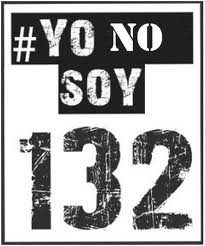
The Path of #YoSoy132

Standard

Here is a link to my latest article on AQBlog, titled “The Path of #YoSoy132“, published on June. 27th, 2012. Please feel free to visit and comment. Here is a verbatim copy of it in case you prefer to read it on my personal blog, though I recommend actually going to the site because of additional content, other blogger’s articles, etc.

#YoSoy132 has been called many things: “the voice of a new generation;” “the Mexican Spring;” and “young people manipulated by the PRD [Partido de la Revolución Democrática, or Party of the Democratic Revolution]” are just a few. Whatever its true nature, this youth movement has left a new mark on electoral processes in Mexico—one which could shape not only the outcome but the aftermath of the 2012 Mexican elections next Sunday.

It all began on May 11 when Enrique Peña Nieto, presidential candidate of the Partido Revolucionario Institucional (Institutional Revolutionary Party—PRI), belittled a group of student protesters that had gathered at the Universidad Iberoamericana to repudiate his presence there. Peña Nieto called them a small group of rabble-rousers, accused them of not being actual students and minimized their protest to opposition made up of only 131 people.

This led to the students uploading a YouTube video showing their university IDs and claiming that their cause was shared by many more young people. The video went viral and the story spiraled into Twitter via the hashtag #YoSoy132 (“I Am 132”). Without a cohesive agenda or clarity with regards to what “being 132” really meant, people sympathized with the students and began retweeting that they too were 132.

A series of strange events followed, making the nature of the movement even less clear and more confusing. Initially, it seemed that the movement’s sole purpose was to demand objective coverage from the largest television news outlet in the country, which allegedly has given favorable coverage to Peña Nieto’s candidacy. However, allegiance to PRD presidential candidate Andrés Manuel López Obrador (AMLO) from some of the movement’s leaders despite being a nonpartisan movement, an inconsistent rhetoric of formally campaigning against Peña Nieto while calling for media objectivity, and conflicting messages from its members have left most Mexicans wondering what it actually means to state that Yo Soy 132

Students attempted to organize; they took to the streets and demanded that the second presidential debate be broadcast over the main TV channels; they held an assembly in order to look for an aligned, common vision. Judging from their concluding declaration and the following fallout of rogue mini-groups, they failed at this objective—but the movement continued to grow in a somewhat chaotic manner. #YoSoy132 was even able to hold a presidential debate on June 19 with an innovative format and the use of internet to connect different students from their homes to pitch questions to candidates. Playing it safe, Peña Nieto declined the invitation to participate.

Recently, the hacktivist group Anonymous, through its Mexico branch, published a video which calls out the federal electoral authority—Institudo Federal Electoral (IFE)—of apparent intention to manipulate the final voting tally in favor of Peña Nieto.

The “preparation for fraud” discourse has been heightened not only by Anonymous, but coincidentally by #YoSoy132 and by AMLO himself. While #YoSoy132 has been threatening that “Si hay imposición habrá revolución” (if there is imposition there will be a revolution), López Obrador has stated that he knows that the PRI is preparing a fraud but his team will be more vigilant to prevent it, similar to his accusations six years ago when he was the presidential runner-up to Felipe Calderón. To make matters more worrisome, the Ejército Popular Revolucionario (Popular Revolutionary Army—EPR) guerrilla group has recently applauded #YoSoy132 and stated that they would take AMLO at his word and support taking arms in order to avoid “a neoliberal candidate” seizing power.

For the sake of any functional democratic state, electoral fraud must be avoided. A system of checks and balances which is actually built in to the Mexican democratic system—including observers and scrutinizers, exit polls, citizen participation in the actual vote counting, and other mechanisms—seems to be insufficient. And while one should not be disingenuous and think that that these mechanisms fully prevent fraudulent practices from taking place from any candidate, a bigger danger is now present: What if #YoSoy132, Anonymous, EPR and others simply don’t like the outcome of the election because their choice did not come out on top, fraud or no fraud? What if Peña Nieto actually and fairly wins but AMLO, as in 2006, does not recognize defeat?

In the first weeks of #YoSoy132 emerging, people started comparing the movement to the Arab Spring and specifically the Egyptian deposition of Hosni Mubarak. While there is simply no comparison between the Mubarak regime and Mexico’s current political and institutional reality, there is one thing in common: Whenever a grassroots movement with no clear agenda, vision, values, or follow-through plan is able to cluster different groups together in order to eliminate or threaten a common enemy, it may be effective in damaging or removing the unwanted player from the mix—but dangerously ineffective in providing a long-term outcome which benefits all those who pulled together. Given the current state of Egypt, Mexicans should learn from this example.

Today, apparently #YoSoy132 means “I don’t want Peña Nieto to win”—but for different reasons. Some support the group because they feel traditional media should not be biased. Others like it because they want AMLO to be the next president. A few think that they support Josefina Vázquez Mota, candidate of the incumbent Partido Acción Nacional (National Action Party—PAN) by saying they are 132. Anonymous seems to want the IFE to be impartial and EPR says that being 132 means taking arms and not supporting the world’s predominant economic model. Some consider being 132 good and active citizenship; others a call to arms against the establishment.

While I applaud the awakened spirit of youth taking a more active role in this election and hope this will mean a larger young voter turnout than what was projected prior to the movement, as long as there is no consensus about what being 132 means, Yo No Soy 132 and I hope for avoidance of post-electoral violence, no matter who Mexico elects as its president this Sunday.

Mexico’s Innovative Youth Offer Hope in the Midst of the Presidential Campaign

Standard

Here is a link to my latest article on AQBlog, titled “Mexico’s Innovative Youth Offer Hope in the Midst of the Presidential Campaign”, published on May. 21st, 2012. Please feel free to visit and comment. Here is a verbatim copy of it in case you prefer to read it on my personal blog, though I recommend actually going to the site because of additional content, other blogger’s articles, etc.

In the midst of Mexico’s presidential election and the heated debate on who is the best candidate, we are reminded of the myopic and paternalistic view citizens still have of this emerging democracy. It is not uncommon to hear people saying they will vote for a candidate because he/she “is the one that will put an end to poverty” (or some other priority development issue) as if the responsibility and power to do so lies solely in an ever-powerful and almighty political leader.

My intention is not to undermine the role government plays in paving the way for development and growth through policies that promote and attract investment and catalyze job creation and opportunities for economic transformation. But the fact is that our political leaders cannot and will not do it alone. For this reason, it is comforting to learn that MIT’s Technology Review recently awarded and recognized 10 innovative young (under age 35) Mexican individuals whose ideas and creations provide a beacon of hope for the country’s future value development.

Mexico needs more people like José Manuel Aguilar from Monterrey, whose participation in developing procedures and a biotechnological platform to make H1N1 vaccines more readily available throughout the country helped stop an immeasurable amounts of deaths during the 2009 crisis. Or 31-year-old Ana Laborde, whose company has developed a patented bioplastic with 70 percent made from Agave waste (the plant used for Tequila manufacturing) and is 100 percent recyclable. Inventions like these are a challenge the country’s mentality of being a provider of raw materials with little added-value to industrialized nations.

Given the national scarcity for jobs, 29-year-old Rodrigo Martínez challenged the traditional recruitment processes and in 2010 launched Wowzer. This platform uses social media and multimedia components to push the boundaries of job creation by building bridges across talent.  Another committed leader is Manuel Wiechers, a 25-year-old industrial engineer whose company, Iluméxico, is responsible for bringing electricity to over 4,000 people in 60 rural towns in Mexico thanks to Prometeo, an intelligent and renewable solar energy panel technology.

Mexico needs the innovative ideas of Javier Gomez, who at age 25 has developed affordable mobile technology to detect heart problems; and Damar López Arredondo whose work in transgenic farming significantly reduces the need for fertilizer use.

These and other young individuals (learn about them here) present inspiring stories of leadership. They are examples of committed Mexican nationals who in their journey for self and professional growth have found ways to contribute to society and give the country specific tools for future development. They provide proof that today and tomorrow, Mexico can abandon the simplistic idea of creating competitive advantage through low-wage manufacturing or natural resources. These 10 individuals create their competitive advantage from an abundance of another, more valuable resource: knowledge.

Does Mexico really want a president who promises to eliminate poverty by waving a magic wand (read their unrealistic proposals)? The answer should be no. I’m hopeful that the country would prefer to vote for a president who understands his/her role in ensuring the promotion of further innovation and development.

The country would benefit from a broader understanding of investment in education. This does not mean merely opening up more low-quality schools run by unionized teachers who fight performance evaluations, but by investing in high-quality upper-level education and creating an improved technical and engineering capability and skill-building mechanism.

A personal tribute to these young leaders and all value-creating citizens. And to MIT and its Technology Review affiliates and sponsors in Mexico (UNAM, BBVA Bancomer, Microsoft, CNN México and others), who by recognizing them with this prestigious award helps their work in the way that more Mexican institutions should.

Mexican Electoral Politics Hit Rock Bottom

Standard

Here is a link to my latest article on AQBlog, titled “Mexican Electoral Politics Hit Rock Bottom”, published on Apr. 17th, 2012. Please feel free to visit and comment. Here is a verbatim copy of it in case you prefer to read it on my personal blog, though I recommend actually going to the site because of additional content, other blogger’s articles, etc.

The 2012 electoral process is the most uninspiring we’ve seen in recent history. Therefore it’s no surprise that Mexican society is increasingly disenfranchised with the political system. In fact, trust in the political elite is at an all-time low. Where interest groups saw possibilities of working hand in hand with the government in 2000 and 2006, the division between those governing and those being governed grows day by day.

The age group most alien to the electoral process this year will be young adults. A recent UNDP-sponsored study carried out by the Universidad Autónoma Metropolitana (UAM) posits that 7 out of every 10 voters ages 18-29 will not turn out to vote due to “disenchantment with Mexican democracy.” Enrique Cuna Pérez, the head of the sociology department at the UAM, points out that Mexican adolescents do believe in democracy but not in the way it is implemented in the country. “Young people are not shying away from democracy as a system, they are shying away from Mexican democracy. They consider themselves as democratic people. They understand the importance of voting but they are not willing to participate in Mexican democracy as it stands today,” says Cuna.

There are many reasons for this. For one, people are finding it harder to believe in and rally for the different candidates. The turn that political campaigns have taken—toward destructive criticism, finger-pointing and whining—is far from inspiring. Since the actual political platforms and proposals show nothing new, candidates are focusing on projecting their persona, trying to get people to believe in them, but they are doing it by saying “you can’t believe in the other candidates” as opposed to showing the country why they are fit to lead.

Enrique Peña Nieto, who according to the latest BGC-Excelsior poll leads the race at 50 percent of voter preference, is doing what he does best: photo-ops with as little speech as possible in the different states he visits. He continues to be the one to beat, though the reason is based more on publicity saturation than substance. Doing what his Partido Revolucionario Institucional (PRI) does best, towns all over the country are now flooded with enormous billboards showing the candidate as a man of the people, hugging an over-eager supporter.

Josefina Vázquez Mota’s party, the ruling Partido Acción Nacional (PAN), has recently launched a tactical attack toward Peña Nieto’s credibility, running radio and television spots that label him a liar based on commitments made during his tenure as governor of Mexico state and presumably did not deliver on. While this may be effective in bringing Peña Nieto’s numbers down, the campaign does nothing to engage young voters or to build up a constructive conversation on the future of the country. The candidate will likely use the upcoming presidential debate to take a stab at Peña Nieto’s list of undelivered promises.

And Andrés Manuel López Obrador? He’s been gradually abandoning his more moderate stance and become militant and combatant. Slowly but surely, we start to see the López of old. Worried about the growing trend of this election becoming a two-person race and himself being relegated to a respectable—but distant third—player (the same poll places him dropping to 20 percent of voter preference, 9 points behind Vázquez Mota), he has chosen to go back to accusing “the system” of being against him and the PRI and PAN of working together to minimize his participation in the race. Most recent outbursts include saying that the upcoming presidential debate structure somehow favors the PRI candidate and that the current PRI-PAN confrontation over Peña Nieto’s credibility is “a smoke screen to detract attention from Peña Nieto’s campaign spending.”

But the presidential race is not the only reason young people have stopped believing in Mexican democracy. A lot of it has to do with the negligence shown by the Mexican Congress, which has hijacked President Felipe Calderón’s proposed structural reforms for political means and become completely stagnant. Add to this the level of impudence shown by all parties with regard to the candidates they’ve put forward for upcoming legislative elections and you start to see why a low voter turnout is likely in 2012.

The party lists include such individuals as Dolores Padierna, wife of René Bejarano who in 2004 was the subject of a video scandal showing him taking wads of cash from a shady Argentine businessman. There’s also Fernando Larrazabal, the mayor from Monterrey whose brother Jonás until recently presumably ran an extortion scheme charging casinos for their right to operate. Emilio Gamboa was the subject of a political scandal in 2006 due to a leaked phone conversation linking him to child pornographer Kamel Nacif.  With this representing part of the future of Mexico’s Congress, it’s no surprise that young voters want nothing to do with it. 

As a result, Mexican electoral politics have hit rock bottom. The political elite would do well to stop ignoring this important trend and work to regain the public’s trust. Otherwise, Mexico’s emerging democracy could prove to be more fragile than they think.

Religious Awakening in Mexico and the Pope’s Visit

Standard

Here is a link to my latest article on AQBlog, titled “Religious Awakening in Mexico and the Pope’s Visit” , published on March 22th, 2012. Please feel free to visit and comment. Here is a verbatim copy of it in case you prefer to read it on my personal blog, though I recommend actually going to the site because of additional content, other blogger’s articles, etc.

—-

Pope Benedict XVI’s first visit to Mexico will begin on March 23 but unlike his predecessor, Benedict will not feel as comfortable calling Mexico siempre fiel—and so hopefully some of his agenda will include discussion on religious diversity. 

Pope John Paul II called Mexico “forever faithful” in 1990 due to Catholicism being the dominant faith in the country. However, rising popularity of other religions and the emergence of atheist and agnostic thought in the country could very well be pushing Mexico to a tipping point, leading to question the favored role Catholicism plays in sociopolitical life.

To this day, many large companies in Mexico (national and international) hold posadas, celebrate Christmas and observe other Catholic holidays such as Easter. Some even hold mass within their facilities to kick off special events. On the flip side, there are very few companies in Mexico that observe Yom Kippur or Ramadan. It is still a commonplace human resource practice to ask potential employees what their religion is during recruitment and—though none will publicly accept it—religion still plays a criteria in actual talent selection (otherwise, why would they ask about it?). This, by the way, is illegal under Article 3 of the Federal Labor Law.

Catholicism is not just favored in the private sector. During the first weeks of December and leading up to the 12th (Day of the Virgen de Guadalupe) Catholics are not only allowed to march on some of the busiest streets in the cities as part of their pilgrimage while causing transit chaos, they are even escorted by public officials to guarantee their safety. This is a nicety not usually awarded to other faiths and it is funded by taxes paid for by people of all faiths.

In Monterrey, people who park in unauthorized spaces close to a Catholic church on Sunday seldom get a ticket and, in the municipality of San Pedro, traffic officials stop cars in order to let the faithful cross the street to and from mass. This is the same municipality which in 1996 famously repealed (without clear legal justification) a permit given to the Mormon Church to build a temple next to a Catholic school. The Mormons were then left with the only option of establishing it in the outskirts of the metropolitan area. 

This differentiated treatment expected and accepted for and by many Catholics, is usually justified through statements such as “95 percent of the country is Catholic so it is ok to favor them” or the less defensive “this special treatment doesn’t hurt anyone. It doesn’t really matter.”

But religious intolerance does hurt society and becomes even more relevant when a critical mass of it is affected.  When my taxes are being used to protect and legitimize a group of people who block an avenue not because they are participating in some form of social protest but just so they can practice their faith, it matters. Every time somebody gets a parking ticket for breaking the law but a Catholic doesn’t because public officials look the other way if the offender is on their way to Sunday mass, it matters.

Moreover, according to the 2000 census the percentage of Mexican Catholics was not 95 percent, but actually 76.5 percent and rapidly dropping. It would be a conservative assumption to think that today at least 30 percent of the population is not Catholic—so when a governmental action disregards or minimizes the beliefs of more than 33 million people in the country, it certainly does matter.

It is understandable that Mexican Catholics would want to hold on to this favored position (who wouldn’t?) but for the sake of social wellbeing, they need to come to terms with the fact that Mexico can no longer be thought of as “a Catholic country.” Forward-thinking companies and government agencies would do well in recognizing that they need to start revising the assumptions under which they operate and evolve their practices in order to become more inclusive. The non-Catholic groups and their rights cannot and should no longer be ignored.

Mexico’s Presidential Race: Running on Air

Standard

Here is a link to my latest article on AQBlog, titled “Mexico’s Presidential Race: Running on Air” , published on Feb. 15th, 2012. Please feel free to visit and comment. Here is a verbatim copy of it in case you prefer to read it on my personal blog, though I recommend actually going to the site because of additional content, other blogger’s articles, etc.

—-

The stage is finally set for the presidential race between Josefina Vázquez Mota (PAN), Andrés Manuel López Obrador (PRD/PT) and Enrique Peña Nieto (PRI/PVEM). What is about to unfold in the coming months is a barrage of party propaganda and news media stories designed to pull the undecided electorate toward one or the other candidates, but the actual content of the messages will surely show the lack of political consciousness in Mexico.

The product of a school system in crisis, a large portion of Mexico’s constituency is comprised of uneducated voters. Moreover, for those lucky enough to have gone through formal schooling, two essential things are missing: development of a widespread civic/political culture and embedding the capacity for critical thinking.  With regard to elections, Mexicans’ decisions have traditionally been based on a simplistic understanding of what candidates represent, if we like the way they talk and even their looks.

 A very young and sensationalist media also works against the creation of a politically informed voter base. Mainstream newspapers and TV networks are more interested in covering and making fun of the latest verbal gaffe by one of the candidates than really doing an in-depth analysis of the actual platforms they are running on. And the worst part is some of the current candidates have caught wind of this so their campaign focus will be less on substance and more on giving the media what they want in order to get more exposure. A secondary concern is the actual proposals and solutions to the country’s biggest challenges.

Of the three candidates, the only one who has provided public discourse with a somewhat clear and consistent direction is López Obrador. To be fair, his campaign is six years ahead of the other two but that doesn’t excuse the fact that Vázquez and Peña have been unable to effectively communicate what they stand for and what their governments would seek. They might not even be trying to do this, as they’ve found they can try to win the election through other strategies.  

Today we know that López Obrador opposes the neoliberal model and his macroeconomic policies are less focused on healthy management of public debt and more on building infrastructure. In his presidency, public spending would likely go up via populist programs, less worried about sustainable finance (the way his administration ran Mexico City). We know he opposes the military’s involvement in the war on drugs and gang-related violence, though we are not yet clear on his proposal for an effective alternative. Because he includes it in his rhetoric, we are clear on his views on supporting the agricultural sector and the ever-pervasive and violent SME (Sindicato Mexicano de Electricistas), a union which represents employees of a public company that doesn’t exist anymore. His foreign affairs policies would likely skew away from the globalization dynamic and steer more toward regional bloc building with Latin America. Somewhat ironically, being open about his platform has done very little to help AMLO gain support. According to a recent poll, his numbers have been stagnant since October 2011 despite heavy campaigning.

Josefina Vázquez Mota will use her political background and take advantage of the gender-role dynamics to position herself as the modern, socially-focused candidate. We will likely see her include education and jobs as the cornerstones of her campaign but her views on the economic model might only be inferred from her allegiance to the PAN party. On her official website, the closest thing to an actual political platform is an invitation to build a national plan through social inclusion and civil participation. Her public appearances follow suit, with statements on how we must build the nation together but lacking substance. Vázquez’ popularity has recently jumped in the polls, catapulting her as the viable alternative for voters who wish to keep the PRI from coming back to power and (at least for now), relegating López to a distant third place position. Her role in the race is being questioned by the media not for her position on any of the issues but by raising the question “is Mexico ready for a woman to be President?”

The leading candidate is still Peña Nieto but his numbers have been on a tailspin due to a series of statements that validate López’ criticism against him for being a “product” or “junk food” candidate. Of the three, Peña is the one whose positions on anything are still a complete mystery.  His public speeches have been empty and unclear. Besides representing the return of PRI to power, Mexicans have no idea what he stands for or his value proposition. He apparently opposes the ruling party’s recent administration but his platform called “An Effective State” provides nothing new, different or innovative that has not already been pushed forward by Calderón’s administration.

Why is Peña leading in the polls?  Because Mexicans do not vote based on substance. Part of his popularity might be attributed to people disappointed of the PAN alternative looking back to the PRI and thinking “we were better off back then.” Add to this Peña’s good looks and his marriage to a soap opera star which helped him gain points early on in the race. However, Peña is running out of fuel and has nothing with which to fill the tank. Until he proves otherwise, Peña is the candidate “running on empty” as López has pointed out. The possibility of either Vázquez or López catching up, is still very much on the table.

It’s too late for this presidential race, but if Mexicans are to make the right decisions in elections to come, we must invest in creating a better informed and politically conscious voter base and we can’t expect the political elite to do it for us. It’s easier for them to run on personal popularity.

*Arjan Shahani is a contributing blogger to AmericasQuarterly.org. He lives in Monterrey, Mexico, and is an MBA graduate from Thunderbird University and Tecnológico de Monterrey and a member of the International Advisory Board of Global Majority—an international non-profit organization dedicated to the promotion of non-violent conflict resolution.

Mexico needs a runoff election process

Standard

Here is a link to my latest article on AQBlog, titled “Mexico Needs a Runoff Process” , published on Jan 13th, 2012. Please feel free to visit and comment. Here is a verbatim copy of it in case you prefer to read it on my personal blog, though I recommend actually going to the site because of additional content, other blogger’s articles, etc.

—-

On July 1, Mexicans will choose their president for the next six years. This will be the fourth time the electoral process is not organized by the government but by a supposedly non-biased institution, the Instituto Federal Electoral or IFE.

Mexico likes to boast (especially since 2000) that we hold free, fair and transparent elections. And while that may be the case to some extent, the country could learn a lot from its Latin American neighbors with regard to the process in itself. More than ever, Mexico would benefit from the implementation of a two-round runoff election as opposed to its current majority rule system.

Prior to 1994, general elections were but a façade to legitimize the perpetuation in power of the Partido Revolucionario Institucional (PRI). Without an independent regulatory body to observe the process, elections results were heavily and systematically manipulated, voting booths with opposition preference were ransacked and official tallies always placed the PRI as an absolute majority winner. Under these circumstances, the official rules of the process were irrelevant and a second round of elections would have never made sense as the PRI would always get over 50 percent of the supposed electorate preference. 

The PRI’s control over elections had been so blatant that the country was led to believe that José López Portillo had won fairly in 1976 with an impressive 87 percent of the vote. In 1988, Carlos Salinas de Gortari was the last president to win an absolute majority (50.7 percent) of the vote.

Not by coincidence, and after four years of the IFE existing, the first non-government organized elections saw Ernesto Zedillo win with only 48.69 percent of the votes in 1994. Besides recovering from the 1994–1995 crisis, which started with the so-called “Error de Diciembre ,” Zedillo’s most important legacy was probably to pave the way for the IFE’s full independence, and thus allow for the democratic transition of power. In 2000, Vicente Fox of the Partido Acción Nacional (PAN) won the election with 42.52 percent of the votes. He was the first president to take power in a situation in which the sum of votes from the two other major parties was actually larger than those awarded to him (52.75 percent between the PRI and a Partido de la Revolución Democrática (PRD)-led alliance). The trend continued in 2006, where President Felipe Calderón (PAN) took power with only 35.89 percent of the votes—a less than 1 percentage point advantage over one of his closest competitor.

Single election, majority rule voting systems work in situations of a two-party system or when one of the candidates is able to conjure up an absolute majority on the first try. But as Mexican electoral history has shown, it’s time to reassess the situation for the country and consider second-round voting.

Mexico has developed into a multiparty system and that system is here to stay. The country has seen the strengthening even of previously discarded small parties such as the PT, PVEM and PANAL. But, more importantly, three major players have emerged and none looks to be going away anytime soon.

Thus, 30/30/30 scenarios become more likely; in fact, since 1994 the country has been run by a person most of its citizens voted against.  This is not just a problem of mathematical relative majority, but  it also reflects on the ability of the leader to govern. It raises the probability that the president might not have been a voter’s second choice had they been given a shot at a runoff.

A two-round system like in Argentina, Chile, Peru, and many other Latin American countries would permit citizens to express their real preferences on round one. Then when two front-runners are left, they could vote for the “least bad” alternative, or as we say in Mexico “el menos peor.”

It would also eliminate the vice of the “useful vote” in which voters cast their vote based on how they think the majority will. In 2006 when Calderón took power, he did so in great part due to “useful votes.” These people did not necessarily agree with Calderón’s proposals or principles but they thought he would be the only one to be able to beat Andrés Manuel López Obrador (PRD) so they gave him their support as a means of blocking the PRD from taking power. While it is understood that in a two-round process the useful vote predicament does appear in the latter round, at least citizens can freely vote their conscience initially. Their first choice can be made for the right reasons and their votes are not thrown out on a whimsical guess.

Runoff elections also provide the elected leader with a level of legitimacy we have not had in Mexico since Zedillo took power. Further, if you consider the fact that elections were fixed before him, one could say that it is a legitimacy no Mexican president has ever had. In clearer terms: no Mexican president has been freely elected by an absolute majority (on a first or second round).

In the 2012 elections people will be voting against PRI because they don’t want them back in power, against PRD because they believe López Obrador to be a danger for the neoliberal model and against PAN because they have deemed them ineffective in the war against drugs and organized crime (and yes, a few constituents will vote for their preferred candidate). This conjecture is way too complex for a single majority vote electoral system to resolve in an effective constructive manner.

Arjan Shahani is a contributing blogger to AmericasQuarterly.org. He lives in Monterrey, Mexico, and is an MBA graduate from Thunderbird University and Tecnológico de Monterrey and a member of the International Advisory Board of Global Majority—an international non-profit organization dedicated to the promotion of non-violent conflict resolution.

A list of articles I published in 2011

Standard

During 2011 I had the honor of writing for Americas Quarterly online blog. They published 19 of my articles. Here are links to each of them. I hope you like looking back on the year through this list. Best wishes for 2012.

The Credibility Vacuum: Mexico’s 2012 Presidential Race

Standard

Here is a link to my latest article on AQBlog, titled “The Credibility Vacuum: Mexico’s 2012 Presidential Race” , published on Nov 28th, 2011. Please feel free to visit and comment.

Here is a verbatim copy of it in case you prefer to read it on my personal blog, though I recommend actually going to the site because of additional content, other blogger’s articles, etc.

—-

No matter the outcome, Mexico’s next president will not have the needed credentials to effectively run this country and neither will the majority parties that compose Congress. Mexico’s political system has entered a credibility vacuum.

These first lines sound fatalist but the real intention here is to prepare and alert the Mexican citizenry of the ever-present need of their active involvement in placing the country on the right track. It has always been simplistic to leave this up to the government and now more than ever, it will be futile to think they would be able to at a federal level.

The 2012 presidential race in Mexico will have three relevant frontrunners: Enrique Peña Nieto (PRI), Andrés Manuel López Obrador (PRD) and if the most recent polls stay the same until February, Josefina Vázquez Mota for PAN.

Vázquez Mota is facing an upstream battle. Of the three, she is the candidate with the least experience, the least media exposure and she has never occupied a publicly-elected government position. Moreover, she carries with her allegiance to a party which in the eyes of many, has failed to capitalize on the democratic transition. The political cost of Vicente Fox’ dormant presidency and Felipe Calderón’s war on drugs-related fatalities puts her in the worst position to win the race. Recent state elections in Estado de México, Coahuila, Nayarit, and Michoacán where the PRI came out victorious, foreshadow PAN’s likely inability to maintain the presidency after 2012. On the off-chance that she could pull it off, Vázquez Mota would govern with a PRI-majority Congress, which most likely would hinder her ability to put forth any relevant changes (same as what happened to Vicente Fox). Vázquez Mota may be the right woman for the job, but she’s in the wrong place at the wrong time.

Though López Obrador’s abandoning of his divisive rhetoric from 2006 gained him a second attempt at the presidency from leftist parties (against my forecasting, I might add), today his flip-flopping positions make him the least credible candidate. His impeachment when he headed the Mexico City government, his irresponsible indebting of the city for his populist gains and his sketchy financing for the past five years make his track record and his current platform incompatible. Moreover, those with a bit of memory will not forgive his utter disregard for the rule of law during the last post-electoral period. 

In the last elections Calderón was able to beat López not because of votes for the PAN candidate but because Calderón was perceived as the “useful vote” for people who wanted to keep a radical López out of the presidency at all costs.  Ironically, with the PAN’s current weak position and López’ confrontational delivery toning down, in 2012 he will likely be the recipient of many anti-PRI votes, possibly enough to get him to power.

If this is the case, Mexico will have yet another demagogue as president; one who has promised too much to too many divergent interest groups in order to try to get a critical mass of support; he will face a real challenge in being able to deliver. His bold statements on creating “a Republic of Love,” getting the armed forces off the streets in six months and creating 4 million jobs in six weeks have been called irresponsible by respected analysts. Add to this the fact that like Vázquez, his every move would most likely be blocked by a PRI Congress.

The third player is Enrique Peña Nieto, the custom-built candidate from the PRI. Called out by López as a “junk-food candidate,” he currently has the favored standing position to win the presidency, though it will most likely end up being a very close race.

Peña’s slick young look and his recent marriage to soap opera star Angélica Rivera equate the couple to the Ken and Barbie of Mexican politics. But what does Peña represent? For one, the return of a party where over 70 years of absolute rule is considered by many the root cause of the current organized crime proliferation in the country. PRI has been gaining ground at a state and municipal level under the banner of “we did know how to govern” and “we controlled (co-opted) the narcos” because citizens have not been able to grasp the benefits of a transition in power and they are tired of the war on drugs.

Related to this, President Calderón has been candid in warning Mexico of the possibility of collusion between drug lords and the PRI should they regain power. As recent allegations of organized crime intrusions favoring PRI in elections in Michoacán show, Calderón’s warnings may not be so far-fetched. Peña Nieto’s candidacy is also tainted by the fact that he will run under a coalition with the PANAL (Partido Nuevo Alianza) supported by Elba Esther Gordillo, president of the SNTE, the combatant teacher’s union and one of Mexico’s most despised political characters.  Rumors of Carlos Salinas de Gortari backing Peña’s candidacy and accusations of Peña’s involvement in the death of his first wife, Monica Petrelini, also warn us of the return of the PRI of old. In addition, TV media moguls and other oligarchs will side with Peña Nieto in order to push him into Los Pinos.

In laymen’s terms Mexicans will have a choice in 2012 to vote for the woman who can’t win, the demagogue who can’t deliver or the pretty boy with shady friends.  In Mexico we are used to voting for the lesser of evils but this time it might be the hardest choice of all.  Given the current scenario, the real challenge will be for the rest of the relevant actors (private enterprise, NGOs, special interest groups, media, universities, trustworthy state and municipal authorities, etc.) to build and achieve progress in spite of the credibility vacuum at the top of the government… and hope for a better race in 2018.

*Arjan Shahani is a contributing blogger to AmericasQuarterly.org. He lives in Monterrey, Mexico, and is an MBA graduate from Thunderbird University and Tecnológico de Monterrey and a member of the International Advisory Board of Global Majority—an international non-profit organization dedicated to the promotion of non-violent conflict resolution.

Hacking for Freedom in Mexico: The Anonymous Movement #OpCartel

Standard

Here is a link to my latest article on AQBlog, titled “Hacking for freedom in Mexico: The Anonymous Movement” , published on Nov 4th, 2011. Please feel free to visit and comment.

Here is a verbatim copy of it in case you prefer to read it on my personal blog, though I recommend actually going to the site because of additional content, other blogger’s articles, etc.

PS. I posted an earlier version of this article on this blog yesterday. This is the up to date version given the fact that the story has evolved since I first wrote  it.

—–

On November 5, if the threats posted are real, Mexico could be witness to a new kind of civil resistance to the status quo and political system. Mexican and international members of the hacker group known as Anonymous, have published through different media (interviews to news papers, YouTube videos and twitter accounts) that although #OpCartel has been cancelled, a former member of the network and independent journalist will divulge information of ties between specific high-level government officials and the criminal organization Los Zetas, initially in the state of Veracruz but potentially in all of the country.

Anonymous officially backed down from unleashing #OpCartel allegedly due to the fact that their kidnapped member was released by the Zetas, but also due to threats from this group of a tenfold retaliation against the families of members in the hacker organization. Barrett Brown’s (@BarrettBrownLOL) decision to reveal information on the drug cartel on his own volition might just be a way to protect the Mexican Anonymous members while continuing to carry out the hacker’s intended agenda. If the campaign is successful, the actions initiated by Anonymous and supposedly continued solely by Brown, could lead to a nationwide political scandal at incisively interesting pre-election times for the country.

In recent articles published here, I’ve posited that regardless of the people in power, Mexico’s core problems are systemic. The political structure in place not only allows, but even invites corrupt practices to take place. Collusion between politicians and criminals is widely suspected. Mexicans know the story all too well and the constant element present in each of the challenges we face as a country is lack of accountability and immense impunity, which is now being challenged by the actions of a rogue hacker group who could open up Pandora’s box and shed some light on the subject.

It would be myopic and pessimistic to say that Mexico’s democracy has not progressed in the last 80 years but in some ways, the country has also taken steps back. Elections have become more free and fair and transparency is advancing to a certain point, but law enforcement has not been able to follow through accordingly. Civil liberties have been strengthened officially but given the state of violence and insecurity in many regions of the country, society would likely tell you that today they feel less free.

Freedom of speech and of the press might be the clearest example of this duality between progress and retreat. During the PRI (Partido de la Revolución Institucional) monopoly of power, press was controlled by limiting or allowing newspapers access to a basic raw material: paper. If the government didn’t like what you wrote, they would simply not sell you the paper to print it. While those days are over, there are now new tactics to attempt to constrict free press: violence against journalists.

According to a recent assessment by the UN and the OAS Mexico is the fifth most dangerous country in the world for journalists. Other organizations and institutions have ranked it as the most dangerous globally. In 2011, 13 journalists have been killed in the country and while investigations have not yet concluded, there is a clear link between these killings and drug cartels/organized crime. Today, newspapers are officially free to publish just about anything, but it is also evident that there are powerful forces at play which put forth new tactics to silence the media. For this reason, cyber activism and the use of new media to overcome violent censorship thru blogs and social networks have recently flourished in the country. Though not unscathed by criminal intent to silence them as well, these informal media allow culprits to enjoy protection through a certain level on anonymity.

Operation Cartel was reportedly born as a means to pressure a drug cartel in Veracruz to release a member of the Anonymous network who had been abducted. But it quickly evolved and grew into something much bigger than the fate of one of its members. On November 2, a message was broadcast across the network saying that they would cancel Operation Cartel as a way to protect the individual whose life was being threatened by the cartel.

But according to a Brown, a former spokesperson, “shortly thereafter, the assembled people held a vote and decided nonetheless to go ahead with the operation.” This is why, even after the release of the victim, Brown plans to move forward on the canceled operation. Both a flaw and virtue, the fact that Anonymous does not have a clear power structure allows for individuals and smaller cells in the network to act independently whilst maintaining that their efforts are coordinated.

In this regard, cyberactivism becomes a strange new force to be reckoned with and as both Egypt and Libya have shown. It is a catalyst for widespread outcry; however, it is a weak means to organize a movement that can actually follow through after reaching its objective. Thus, the fallout of Operation Cartel could potentially be immensely disruptive and lead to political crisis, but I am unsure that it could lead to a clear effort to fix the system. Members from Anonymous in Mexico have even stated that they are non-political, though they do say they want to create a social conscience. Does Anonymous have the moral and role legitimacy to do this? Are they the new voice of the global people? Does it matter if they are or not?

A bigger question to pose would be if Anonymous’ Operations will always strive for social justice (defined by whom?) and with the loose level of allegiance that a network can create as opposed to a formal organization, what would stop cyber activists from straying away of the group and chasing a different agenda?

For now, Mexico anxiously waits to see what Barret Brown will do. Many champion this effort as a new and creative means to tackle a problem that for too long has been a tragedy of the commons in Mexico. As the tagline from the movie that inspired Anonymous goes, we are about to see if Mexico will remember the 5th of November.

*Arjan Shahani is a contributing blogger to AmericasQuarterly.org. He lives in Monterrey, Mexico, and is an MBA graduate from Thunderbird University and Tecnológico de Monterrey and a member of the International Advisory Board of Global Majority—an international non-profit organization dedicated to the promotion of non-violent conflict resolution.