Mexico is Flunking in Education

Standard

Here is a link to my latest article on AQBlog, titled “Mexico is Flunking in Education“, published on July 25th, 2012. Please feel free to visit and comment. Here is a verbatim copy of it in case you prefer to read it on my personal blog, though I recommend actually going to the site because of additional content, other blogger’s articles, etc.

On July 22, the Mexican Education Ministry (Secretaría de Educación Pública, or SEP) published the results for the Knowledge, Ability and Teaching Skills National Exam, the annual test the Mexican government uses to award teaching positions in the country. The outcome paints a grim picture for children seeking quality education in Mexico.

A year ago, I wrote about the fact that the test in itself is not exigent enough and that the passing grade is a meager 30 percent. Back then I took a deep dive into the way the test is structured and concluded that it was practically impossible to fail. Well the results are in, and unfortunately, I underestimated the level of ignorance in the people responsible for preparing Mexico’s youth for the challenges of tomorrow. There’s something categorically wrong in Mexico’s education system when out of 134,704 people that took this simple test, over 70 percent don’t get half of it right and only 309 (0.2 percent) get a perfect score.

Of the over 18,000 teaching-position vacancies that will be filled this year, 309 applicants are up to par based on the already low standards SEP was able to negotiate with the National Educational Workers Union (SNTE). The rest of our new teachers present huge deficiencies in curricular content (actual subject matter), scholastic competencies, logic, and/or ethics.

This test was applied in all Mexican states except Michoacán and Oaxaca, where the teacher’s union is controlled by the National Educational Workers Coordinator (CNTE), a group which has opposed teacher evaluations in general and is even more radical than Elba Esther Gordillo’s SNTE. One can only imagine what the outcome of the test would have been in these entities. And if the teachers are flunking out, it doesn’t take a genius to figure out what is happening with the students, which is good, because we apparently don’t have too many of them anyways (geniuses, not students).

Election after election, Mexico has heard the same story. In every race, candidates point to education as a critical issue and yet these promises seldom become more than empty political rhetoric. There are a number of reasons for this:

Amount of money is not the main issue. Contrary to popular belief, the education problem in Mexico has less to do with available federal budget resources and more to do with their allocation. About 5.3 percent of Mexico’s GDP goes to education. That’s more than Canada, Costa Rica and Australia and just under the United States. The problem is that while these countries actually invest in the quality of their teachers and improvements in infrastructure, Mexico’s education budget is funneled through depraved unions and very little actually seeps through to the schools.

There is no short-term incentive for long-term projects. Mexico’s federal projects and plans are created on a six-year window. Without reelection the president has no real reason to invest in a project that will not deliver tangible results during his tenure. The Minister of Education has little hopes for running for president (though Ernesto Zedillo did and won and recently Josefina Vázquez Mota had a run for the position but failed miserably) and even so, they can always blame the unions for the education having stagnated. Conversely, union leaders, which do not change every six years, have clear interests in maintaining control and power so it is in their interest to favor teachers above student development. The less that they have to hold their constituencies accountable for quality in the work, the more likely they are to continue reaping the benefits of leading the unions.

Our education system is based on memorization and not critical thinking. Students are “taught” to memorize dates and events, multiplication tables, etc. but going back to the question of quality in education, Mexico still has a long way to go. Here, the overwhelming role catholic religion plays in our children’s youth does not help at all. Mexico is not breeding thinkers or leaders; we’re raising followers and record players. We cannot keep pouring money into a system that’s broken in its core. A complete revamping of what is taught and how it is taught is needed for the system to evolve.

Myopically, low levels of education serve the political parties’ interests. It’s easier to get votes out of a dumbed-down constituency than a critical one. There is no clearer example of parties’ narrow-minded take on elections than the presidential race Mexico has just completed. Moreover, as long as our national economic projects continue to point toward cheap labor as Mexico’s source of competitive advantage, there is no real incentive to migrate to an economy of knowledge.

Literacy rates are can easily deceive. According to the CIA World Factbook Mexico has a 86.1 percent literacy rate but evidently, knowing how to read and understanding what it is that we are reading is not the same. PISA (Programme for International Student Assessment) places Mexico’s reading comprehension levels second to last among OECD countries. Canada, which spends less of its GDP on education is almost on top of the list, only bested by Finland. It’s clear that having an over 85 percent literacy rate is in itself, nothing to brag about.

What’s the solution?

More important than “what”, “who” is the key to solving the education problem in Mexico. There are at least two specific groups that need to band together in order to pressure the government to deliver on education programs.

Organized civil society has to take a more active role in ensuring that governments are accountable for what they promise. We have to demand more from our elected officials. Hopefully the social mobilization momentum created around the recent elections can be proactively directed toward this endeavor. The second group that needs to take an active role in education is not surprisingly, the private sector. More businesses need to understand that by fostering, promoting and supporting better education programs, they are investing in more wealth creation capabilities in their consumers and thus, more business. It just makes sense for big business to partner with civil society and government in implementing effective education programs which will give them return on investment in the long run.
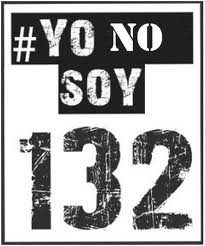
The Path of #YoSoy132

Standard

Here is a link to my latest article on AQBlog, titled “The Path of #YoSoy132“, published on June. 27th, 2012. Please feel free to visit and comment. Here is a verbatim copy of it in case you prefer to read it on my personal blog, though I recommend actually going to the site because of additional content, other blogger’s articles, etc.

#YoSoy132 has been called many things: “the voice of a new generation;” “the Mexican Spring;” and “young people manipulated by the PRD [Partido de la Revolución Democrática, or Party of the Democratic Revolution]” are just a few. Whatever its true nature, this youth movement has left a new mark on electoral processes in Mexico—one which could shape not only the outcome but the aftermath of the 2012 Mexican elections next Sunday.

It all began on May 11 when Enrique Peña Nieto, presidential candidate of the Partido Revolucionario Institucional (Institutional Revolutionary Party—PRI), belittled a group of student protesters that had gathered at the Universidad Iberoamericana to repudiate his presence there. Peña Nieto called them a small group of rabble-rousers, accused them of not being actual students and minimized their protest to opposition made up of only 131 people.

This led to the students uploading a YouTube video showing their university IDs and claiming that their cause was shared by many more young people. The video went viral and the story spiraled into Twitter via the hashtag #YoSoy132 (“I Am 132”). Without a cohesive agenda or clarity with regards to what “being 132” really meant, people sympathized with the students and began retweeting that they too were 132.

A series of strange events followed, making the nature of the movement even less clear and more confusing. Initially, it seemed that the movement’s sole purpose was to demand objective coverage from the largest television news outlet in the country, which allegedly has given favorable coverage to Peña Nieto’s candidacy. However, allegiance to PRD presidential candidate Andrés Manuel López Obrador (AMLO) from some of the movement’s leaders despite being a nonpartisan movement, an inconsistent rhetoric of formally campaigning against Peña Nieto while calling for media objectivity, and conflicting messages from its members have left most Mexicans wondering what it actually means to state that Yo Soy 132

Students attempted to organize; they took to the streets and demanded that the second presidential debate be broadcast over the main TV channels; they held an assembly in order to look for an aligned, common vision. Judging from their concluding declaration and the following fallout of rogue mini-groups, they failed at this objective—but the movement continued to grow in a somewhat chaotic manner. #YoSoy132 was even able to hold a presidential debate on June 19 with an innovative format and the use of internet to connect different students from their homes to pitch questions to candidates. Playing it safe, Peña Nieto declined the invitation to participate.

Recently, the hacktivist group Anonymous, through its Mexico branch, published a video which calls out the federal electoral authority—Institudo Federal Electoral (IFE)—of apparent intention to manipulate the final voting tally in favor of Peña Nieto.

The “preparation for fraud” discourse has been heightened not only by Anonymous, but coincidentally by #YoSoy132 and by AMLO himself. While #YoSoy132 has been threatening that “Si hay imposición habrá revolución” (if there is imposition there will be a revolution), López Obrador has stated that he knows that the PRI is preparing a fraud but his team will be more vigilant to prevent it, similar to his accusations six years ago when he was the presidential runner-up to Felipe Calderón. To make matters more worrisome, the Ejército Popular Revolucionario (Popular Revolutionary Army—EPR) guerrilla group has recently applauded #YoSoy132 and stated that they would take AMLO at his word and support taking arms in order to avoid “a neoliberal candidate” seizing power.

For the sake of any functional democratic state, electoral fraud must be avoided. A system of checks and balances which is actually built in to the Mexican democratic system—including observers and scrutinizers, exit polls, citizen participation in the actual vote counting, and other mechanisms—seems to be insufficient. And while one should not be disingenuous and think that that these mechanisms fully prevent fraudulent practices from taking place from any candidate, a bigger danger is now present: What if #YoSoy132, Anonymous, EPR and others simply don’t like the outcome of the election because their choice did not come out on top, fraud or no fraud? What if Peña Nieto actually and fairly wins but AMLO, as in 2006, does not recognize defeat?

In the first weeks of #YoSoy132 emerging, people started comparing the movement to the Arab Spring and specifically the Egyptian deposition of Hosni Mubarak. While there is simply no comparison between the Mubarak regime and Mexico’s current political and institutional reality, there is one thing in common: Whenever a grassroots movement with no clear agenda, vision, values, or follow-through plan is able to cluster different groups together in order to eliminate or threaten a common enemy, it may be effective in damaging or removing the unwanted player from the mix—but dangerously ineffective in providing a long-term outcome which benefits all those who pulled together. Given the current state of Egypt, Mexicans should learn from this example.

Today, apparently #YoSoy132 means “I don’t want Peña Nieto to win”—but for different reasons. Some support the group because they feel traditional media should not be biased. Others like it because they want AMLO to be the next president. A few think that they support Josefina Vázquez Mota, candidate of the incumbent Partido Acción Nacional (National Action Party—PAN) by saying they are 132. Anonymous seems to want the IFE to be impartial and EPR says that being 132 means taking arms and not supporting the world’s predominant economic model. Some consider being 132 good and active citizenship; others a call to arms against the establishment.

While I applaud the awakened spirit of youth taking a more active role in this election and hope this will mean a larger young voter turnout than what was projected prior to the movement, as long as there is no consensus about what being 132 means, Yo No Soy 132 and I hope for avoidance of post-electoral violence, no matter who Mexico elects as its president this Sunday.

Mexico’s Innovative Youth Offer Hope in the Midst of the Presidential Campaign

Standard

Here is a link to my latest article on AQBlog, titled “Mexico’s Innovative Youth Offer Hope in the Midst of the Presidential Campaign”, published on May. 21st, 2012. Please feel free to visit and comment. Here is a verbatim copy of it in case you prefer to read it on my personal blog, though I recommend actually going to the site because of additional content, other blogger’s articles, etc.

In the midst of Mexico’s presidential election and the heated debate on who is the best candidate, we are reminded of the myopic and paternalistic view citizens still have of this emerging democracy. It is not uncommon to hear people saying they will vote for a candidate because he/she “is the one that will put an end to poverty” (or some other priority development issue) as if the responsibility and power to do so lies solely in an ever-powerful and almighty political leader.

My intention is not to undermine the role government plays in paving the way for development and growth through policies that promote and attract investment and catalyze job creation and opportunities for economic transformation. But the fact is that our political leaders cannot and will not do it alone. For this reason, it is comforting to learn that MIT’s Technology Review recently awarded and recognized 10 innovative young (under age 35) Mexican individuals whose ideas and creations provide a beacon of hope for the country’s future value development.

Mexico needs more people like José Manuel Aguilar from Monterrey, whose participation in developing procedures and a biotechnological platform to make H1N1 vaccines more readily available throughout the country helped stop an immeasurable amounts of deaths during the 2009 crisis. Or 31-year-old Ana Laborde, whose company has developed a patented bioplastic with 70 percent made from Agave waste (the plant used for Tequila manufacturing) and is 100 percent recyclable. Inventions like these are a challenge the country’s mentality of being a provider of raw materials with little added-value to industrialized nations.

Given the national scarcity for jobs, 29-year-old Rodrigo Martínez challenged the traditional recruitment processes and in 2010 launched Wowzer. This platform uses social media and multimedia components to push the boundaries of job creation by building bridges across talent.  Another committed leader is Manuel Wiechers, a 25-year-old industrial engineer whose company, Iluméxico, is responsible for bringing electricity to over 4,000 people in 60 rural towns in Mexico thanks to Prometeo, an intelligent and renewable solar energy panel technology.

Mexico needs the innovative ideas of Javier Gomez, who at age 25 has developed affordable mobile technology to detect heart problems; and Damar López Arredondo whose work in transgenic farming significantly reduces the need for fertilizer use.

These and other young individuals (learn about them here) present inspiring stories of leadership. They are examples of committed Mexican nationals who in their journey for self and professional growth have found ways to contribute to society and give the country specific tools for future development. They provide proof that today and tomorrow, Mexico can abandon the simplistic idea of creating competitive advantage through low-wage manufacturing or natural resources. These 10 individuals create their competitive advantage from an abundance of another, more valuable resource: knowledge.

Does Mexico really want a president who promises to eliminate poverty by waving a magic wand (read their unrealistic proposals)? The answer should be no. I’m hopeful that the country would prefer to vote for a president who understands his/her role in ensuring the promotion of further innovation and development.

The country would benefit from a broader understanding of investment in education. This does not mean merely opening up more low-quality schools run by unionized teachers who fight performance evaluations, but by investing in high-quality upper-level education and creating an improved technical and engineering capability and skill-building mechanism.

A personal tribute to these young leaders and all value-creating citizens. And to MIT and its Technology Review affiliates and sponsors in Mexico (UNAM, BBVA Bancomer, Microsoft, CNN México and others), who by recognizing them with this prestigious award helps their work in the way that more Mexican institutions should.

Mexican Electoral Politics Hit Rock Bottom

Standard

Here is a link to my latest article on AQBlog, titled “Mexican Electoral Politics Hit Rock Bottom”, published on Apr. 17th, 2012. Please feel free to visit and comment. Here is a verbatim copy of it in case you prefer to read it on my personal blog, though I recommend actually going to the site because of additional content, other blogger’s articles, etc.

The 2012 electoral process is the most uninspiring we’ve seen in recent history. Therefore it’s no surprise that Mexican society is increasingly disenfranchised with the political system. In fact, trust in the political elite is at an all-time low. Where interest groups saw possibilities of working hand in hand with the government in 2000 and 2006, the division between those governing and those being governed grows day by day.

The age group most alien to the electoral process this year will be young adults. A recent UNDP-sponsored study carried out by the Universidad Autónoma Metropolitana (UAM) posits that 7 out of every 10 voters ages 18-29 will not turn out to vote due to “disenchantment with Mexican democracy.” Enrique Cuna Pérez, the head of the sociology department at the UAM, points out that Mexican adolescents do believe in democracy but not in the way it is implemented in the country. “Young people are not shying away from democracy as a system, they are shying away from Mexican democracy. They consider themselves as democratic people. They understand the importance of voting but they are not willing to participate in Mexican democracy as it stands today,” says Cuna.

There are many reasons for this. For one, people are finding it harder to believe in and rally for the different candidates. The turn that political campaigns have taken—toward destructive criticism, finger-pointing and whining—is far from inspiring. Since the actual political platforms and proposals show nothing new, candidates are focusing on projecting their persona, trying to get people to believe in them, but they are doing it by saying “you can’t believe in the other candidates” as opposed to showing the country why they are fit to lead.

Enrique Peña Nieto, who according to the latest BGC-Excelsior poll leads the race at 50 percent of voter preference, is doing what he does best: photo-ops with as little speech as possible in the different states he visits. He continues to be the one to beat, though the reason is based more on publicity saturation than substance. Doing what his Partido Revolucionario Institucional (PRI) does best, towns all over the country are now flooded with enormous billboards showing the candidate as a man of the people, hugging an over-eager supporter.

Josefina Vázquez Mota’s party, the ruling Partido Acción Nacional (PAN), has recently launched a tactical attack toward Peña Nieto’s credibility, running radio and television spots that label him a liar based on commitments made during his tenure as governor of Mexico state and presumably did not deliver on. While this may be effective in bringing Peña Nieto’s numbers down, the campaign does nothing to engage young voters or to build up a constructive conversation on the future of the country. The candidate will likely use the upcoming presidential debate to take a stab at Peña Nieto’s list of undelivered promises.

And Andrés Manuel López Obrador? He’s been gradually abandoning his more moderate stance and become militant and combatant. Slowly but surely, we start to see the López of old. Worried about the growing trend of this election becoming a two-person race and himself being relegated to a respectable—but distant third—player (the same poll places him dropping to 20 percent of voter preference, 9 points behind Vázquez Mota), he has chosen to go back to accusing “the system” of being against him and the PRI and PAN of working together to minimize his participation in the race. Most recent outbursts include saying that the upcoming presidential debate structure somehow favors the PRI candidate and that the current PRI-PAN confrontation over Peña Nieto’s credibility is “a smoke screen to detract attention from Peña Nieto’s campaign spending.”

But the presidential race is not the only reason young people have stopped believing in Mexican democracy. A lot of it has to do with the negligence shown by the Mexican Congress, which has hijacked President Felipe Calderón’s proposed structural reforms for political means and become completely stagnant. Add to this the level of impudence shown by all parties with regard to the candidates they’ve put forward for upcoming legislative elections and you start to see why a low voter turnout is likely in 2012.

The party lists include such individuals as Dolores Padierna, wife of René Bejarano who in 2004 was the subject of a video scandal showing him taking wads of cash from a shady Argentine businessman. There’s also Fernando Larrazabal, the mayor from Monterrey whose brother Jonás until recently presumably ran an extortion scheme charging casinos for their right to operate. Emilio Gamboa was the subject of a political scandal in 2006 due to a leaked phone conversation linking him to child pornographer Kamel Nacif.  With this representing part of the future of Mexico’s Congress, it’s no surprise that young voters want nothing to do with it. 

As a result, Mexican electoral politics have hit rock bottom. The political elite would do well to stop ignoring this important trend and work to regain the public’s trust. Otherwise, Mexico’s emerging democracy could prove to be more fragile than they think.

A list of articles I published in 2011

Standard

During 2011 I had the honor of writing for Americas Quarterly online blog. They published 19 of my articles. Here are links to each of them. I hope you like looking back on the year through this list. Best wishes for 2012.

Te quiero, México

Standard

Hace un año y con cierto grado de idealismo, escribí para Americas Quarterly que el propósito de año nuevo para México debería ser no ejercer en actos de corrupción. Al cierre del 2011 me parece importante revisar si por lo menos de manera personal, cumplí con las metas que planteaba.

1. No pagué mordidas. Cumplí este propósito. Durante todo el 2011 no les di a oficiales de tránsito un solo peso para evitar multas. Nunca les dije ¿cómo nos arreglamos? Ni caí ante invitaciones por parte de ellos a jugar este nocivo juego. Debo decir, orgullosamente, que incluso fui más cuidadoso y cordial al volante. Creo que por lo menos en Monterrey, este año varios cambiamos nuestros hábitos de manejo. La razón no es loable: no queremos llamar la atención o provocar porque tenemos miedo de los demás. Ante la posibilidad de que la gente con la que compartimos la calle porte arma o sea miembro del crimen organizado, nos hemos vuelto más civiles… especialmente frente a las pickups. Un extraño y cuasipositivo efecto secundario de la apabullante criminalidad. 

2. No evadí impuestos. Incluso ante la complejidad que existe de tener un régimen compuesto al tener varios patrones o trabajar por honorarios, este año me avoqué a mi actividad primaria y no ejercí en consultoría, lo cual hará mi declaración anual mucho más simple. Desgraciadamente el actual régimen fiscal desincentiva que quienes podríamos tener dos o tres trabajos lo hagamos, ya que complica y acrecenta la carga impositiva (otra de muchas cosas que deberían de mejorar). No pretendo meter una sola factura falsa (nunca lo he hecho) para hacer deducciones jugando al juego de “mientras no me auditen no pasa nada.” No estoy para nada conforme con la manera en que mis impuestos se administran pero tomar esto como excusa para incumplir es algo que no me permitiré. El buen actuar tiene que empezar en alguien y si sigo esperando que sean las autoridades las que lo comiencen, me quedaré esperando toda la vida. En este tema y habiendo leído las propuestas que uno de los candidatos a la presidencia tiene en que propondría que quienes son más productivos paguen más impuestos, aprovecho para decir que me parece retrograda y ridículo. La generación de valor debe ser fomentada y no castigada. El problema de los impuestos en México tiene dos aristas y ninguna de ellas se resuelve sustentablemente poniendo más impuestos a los cautivos: una de ellas es la base gravable. Es ridículo el tamaño de la economía informal que existe en el país. La otra es la administración irresponsable de lo recaudado. Insisto, proponer subir los brackets del ISR de manera más desproporcionada de lo que ya están, es una propuesta populista e inherentemente contraproducente… pero volvamos a la evaluación de mi cumplimiento de propósitos del año. 

3. No compré piratería. Por más que me hubiera gustado ver algunas películas que no pude ir al cine a ver, por más que sólo quería una canción y no todo el álbum, no gasté en productos pirata de ningún tipo este año. Comprar piratería es algo que en mi casa no se tolera. Es una regla que he impuesto y que formará a mis hijos cuando vayan creciendo. Seguramente les costará cuando vean a sus amiguitos llegar con el nuevo videojuego que pudieron comprar porque fue en un puesto de la calle y viene con los créditos en chino, pero estaré contribuyendo a que sean más honestos. Uno tiene que empezar en su casa. 

4. Fallé en mi propósito de vigilar y demandar mayor efectividad de mis gobernantes. Me mantuve informado durante todo el año pero sé que podría haber hecho mucho más. Quedo debiendo en esta parte del propósito tristemente. Sin embargo, tengo el siguiente año para mejorar. El 2012 además incluirá una muy importante y difícil decisión para todos los mexicanos que formamos parte del padrón electoral: votaremos en elecciones presidenciales. Mi compromiso es estudiar las plataformas y propuestas de los candidatos para que mi elección se haga de manera informada y no como resultado de propaganda electoral. Votaré a conciencia y con los elementos que considero necesarios para tomar la mejor decisión.

5. No implementé prácticas de negocio cuestionables. Mis relaciones cliente-proveedor fueron siempre transparentes. Mi selección de proveedores nunca respondió a compadrazgos ni a obsequios de ningún tipo. Nuestra disciplina presupuestaria fue impecable y transparente. Desde mi trinchera promoví que las personas a mi alrededor actuaran conforme a los ideales plasmados en el juramento que tomé ante Thunderbird University. 

En retrospectiva, debo decir que estoy en paz con mí ejercer durante el 2011. Creo que en su gran mayoría, cumplí con los compromisos que pensé necesarios para dar un paso hacia adelante y contribuir a la sociedad en su muy necesaria revitalización.  ¿Puedo hacer más? Definitivamente. 

Durante el 2012, daré el siguiente paso. Habiendo empezado por mí mismo, el siguiente año asumiré el compromiso de promover más activamente que la gente a mi alrededor se una a los esfuerzos que muchos estamos tomando para forjar una cultura de legalidad. No estaría cómodo conmigo de otra manera.

Te deseo un muy feliz 2012, México. Que el año que comienza sirva para renovarte y extraer de ti todo el potencial que sé que llevas dentro, que cargas en toda tu gente. Te deseo que crezcamos juntos y nos volvamos mejores; que abandonemos viejas y primitivas ideas que nos mantienen en una mentalidad de sometidos. Te deseo que nos volvamos en una economía sustentada en el valor de nuestras ideas y no de nuestros recursos primarios. Te deseo que si bien no la eliminamos, sí avancemos en aminorar la estratificación social que nos mantiene tan distantes a quienes somos tus ciudadanos, que justificamos nuestros actos de violencia en la irracionalidad. Te deseo unión entre tus habitantes y no división alimentada de odios y envidias (a pesar de que algunas campañas presidenciales a eso se evocarán). 

Te quiero mucho, México. Feliz Año Nuevo.

The Credibility Vacuum: Mexico’s 2012 Presidential Race

Standard

Here is a link to my latest article on AQBlog, titled “The Credibility Vacuum: Mexico’s 2012 Presidential Race” , published on Nov 28th, 2011. Please feel free to visit and comment.

Here is a verbatim copy of it in case you prefer to read it on my personal blog, though I recommend actually going to the site because of additional content, other blogger’s articles, etc.

—-

No matter the outcome, Mexico’s next president will not have the needed credentials to effectively run this country and neither will the majority parties that compose Congress. Mexico’s political system has entered a credibility vacuum.

These first lines sound fatalist but the real intention here is to prepare and alert the Mexican citizenry of the ever-present need of their active involvement in placing the country on the right track. It has always been simplistic to leave this up to the government and now more than ever, it will be futile to think they would be able to at a federal level.

The 2012 presidential race in Mexico will have three relevant frontrunners: Enrique Peña Nieto (PRI), Andrés Manuel López Obrador (PRD) and if the most recent polls stay the same until February, Josefina Vázquez Mota for PAN.

Vázquez Mota is facing an upstream battle. Of the three, she is the candidate with the least experience, the least media exposure and she has never occupied a publicly-elected government position. Moreover, she carries with her allegiance to a party which in the eyes of many, has failed to capitalize on the democratic transition. The political cost of Vicente Fox’ dormant presidency and Felipe Calderón’s war on drugs-related fatalities puts her in the worst position to win the race. Recent state elections in Estado de México, Coahuila, Nayarit, and Michoacán where the PRI came out victorious, foreshadow PAN’s likely inability to maintain the presidency after 2012. On the off-chance that she could pull it off, Vázquez Mota would govern with a PRI-majority Congress, which most likely would hinder her ability to put forth any relevant changes (same as what happened to Vicente Fox). Vázquez Mota may be the right woman for the job, but she’s in the wrong place at the wrong time.

Though López Obrador’s abandoning of his divisive rhetoric from 2006 gained him a second attempt at the presidency from leftist parties (against my forecasting, I might add), today his flip-flopping positions make him the least credible candidate. His impeachment when he headed the Mexico City government, his irresponsible indebting of the city for his populist gains and his sketchy financing for the past five years make his track record and his current platform incompatible. Moreover, those with a bit of memory will not forgive his utter disregard for the rule of law during the last post-electoral period. 

In the last elections Calderón was able to beat López not because of votes for the PAN candidate but because Calderón was perceived as the “useful vote” for people who wanted to keep a radical López out of the presidency at all costs.  Ironically, with the PAN’s current weak position and López’ confrontational delivery toning down, in 2012 he will likely be the recipient of many anti-PRI votes, possibly enough to get him to power.

If this is the case, Mexico will have yet another demagogue as president; one who has promised too much to too many divergent interest groups in order to try to get a critical mass of support; he will face a real challenge in being able to deliver. His bold statements on creating “a Republic of Love,” getting the armed forces off the streets in six months and creating 4 million jobs in six weeks have been called irresponsible by respected analysts. Add to this the fact that like Vázquez, his every move would most likely be blocked by a PRI Congress.

The third player is Enrique Peña Nieto, the custom-built candidate from the PRI. Called out by López as a “junk-food candidate,” he currently has the favored standing position to win the presidency, though it will most likely end up being a very close race.

Peña’s slick young look and his recent marriage to soap opera star Angélica Rivera equate the couple to the Ken and Barbie of Mexican politics. But what does Peña represent? For one, the return of a party where over 70 years of absolute rule is considered by many the root cause of the current organized crime proliferation in the country. PRI has been gaining ground at a state and municipal level under the banner of “we did know how to govern” and “we controlled (co-opted) the narcos” because citizens have not been able to grasp the benefits of a transition in power and they are tired of the war on drugs.

Related to this, President Calderón has been candid in warning Mexico of the possibility of collusion between drug lords and the PRI should they regain power. As recent allegations of organized crime intrusions favoring PRI in elections in Michoacán show, Calderón’s warnings may not be so far-fetched. Peña Nieto’s candidacy is also tainted by the fact that he will run under a coalition with the PANAL (Partido Nuevo Alianza) supported by Elba Esther Gordillo, president of the SNTE, the combatant teacher’s union and one of Mexico’s most despised political characters.  Rumors of Carlos Salinas de Gortari backing Peña’s candidacy and accusations of Peña’s involvement in the death of his first wife, Monica Petrelini, also warn us of the return of the PRI of old. In addition, TV media moguls and other oligarchs will side with Peña Nieto in order to push him into Los Pinos.

In laymen’s terms Mexicans will have a choice in 2012 to vote for the woman who can’t win, the demagogue who can’t deliver or the pretty boy with shady friends.  In Mexico we are used to voting for the lesser of evils but this time it might be the hardest choice of all.  Given the current scenario, the real challenge will be for the rest of the relevant actors (private enterprise, NGOs, special interest groups, media, universities, trustworthy state and municipal authorities, etc.) to build and achieve progress in spite of the credibility vacuum at the top of the government… and hope for a better race in 2018.

*Arjan Shahani is a contributing blogger to AmericasQuarterly.org. He lives in Monterrey, Mexico, and is an MBA graduate from Thunderbird University and Tecnológico de Monterrey and a member of the International Advisory Board of Global Majority—an international non-profit organization dedicated to the promotion of non-violent conflict resolution.

History occurs faster than publishing… #OpCartel

Standard

I was going to get a story on Anonymous’ #OpCartel published at AQBlog, most likely tomorrow, but I just learned that the hacker group’s operation has been cancelled due to the fact that the drug cartel released the kidnapped hacker. An independent journalist abroad has stated that he will carry out the operation but independently from Anonymous, as the group has been threatened by the cartel with dire repercussions and retaliation if they follow through on their threats to publish the names of government officials linked to organized crime…

Anyways, I will probably end up editing the story in order to update it before it goes online at the Americas Quarterly blog but I wanted to share with you the original story, as it was written and intended. I’ll let you know when the updated story also goes online.

I hope you like it:
Hacking for freedom in Mexico

 On November 5th, if the threats posted are real, Mexico could be witness to a new kind of civil resistance to the status quo and political system. Mexican and international members of the hacker group known as Anonymous, have published through different media (interviews to news papers, YouTube videos and twitter accounts) that on said date they will unleash “Operation Cartel” informing the world of ties between specific high-level government officials and the criminal organization Los Zetas, initially in the state of Veracruz but potentially in all of the country. If Anonymous is successful, their actions could lead to a nation-wide political scandal at incisively interesting pre-election times for the country.

 In recent articles published here, I’ve posited that regardless of the people in power, Mexico’s core problems are systemic. The political structure in place not only allows, but even invites corrupt practices to take place. Collusion between politicians and criminals is widely suspected. Mexicans know the story all too well and the constant element present in each of the challenges we face as a country is lack of accountability and immense impunity, which is now being challenged by a rogue hacker group who threatens to open up Pandora’s box and shed some light on the subject.

 It would be myopic and pessimistic to say that Mexico’s democracy has not progressed in the last 80 years but in some ways, the country has also taken steps back. Elections have become more free and fair and transparency is advancing to a certain point, but law enforcement has not been able to follow through accordingly. Civil liberties have been strengthened officially but given the state of violence and insecurity in many regions of the country, society would likely tell you that today they feel less free. 

 Freedom of speech and of the press might be the clearest example of this duality between progress and retreat. During the PRI (Partido de la Revolución Institucional) monopoly of power, press was controlled by limiting or allowing newspapers access to a basic raw material: paper. If the government didn’t like what you wrote, they would simply not sell you the paper to print it on. While those days are over, there are now new tactics to attempt to constrict free press: violence against journalists.

 According to a recent assessment by the UN and the OAS Mexico is the fifth most dangerous country in the world for journalists. Other organizations and institutions have ranked it as the most dangerous world-wide. In 2011, 13 journalists have been killed in the country and while investigations have not yet concluded, there is a clear link between these killings and drug cartels/organized crime. Today, newspapers are officially free to publish just about anything, but it is also evident that there are powerful forces at play which put forth new tactics to silence the media. For this reason, cyber activism and the use of new media to overcome violent censorship thru blogs and social networks have recently flourished in the country. Though not unscathed by criminal intent to silence them as well, these informal media allow culprits to enjoy protection through a certain level on anonymity.   

 Operation Cartel was reportedly born as a means to pressure a drug cartel in Veracruz to release a member of the Anonymous network which had been abducted, but quickly evolved and grew into something much bigger than the fate of one of its members. On November 2nd, a message was broadcast across the network saying that they would cancel Operation Cartel as a way to protect the individual whose life was being threatened by the cartel but according to a former spokesperson, “shortly thereafter, the assembled people held a vote and decided nonethless to go ahead with the operation.” Both a flaw and virtue, the fact that Anonymous does not have a clear power structure allows for individuals and smaller cells in the network to act independently whilst maintaining that their efforts are coordinated.

 In this regard, cyberactivism becomes a strange new force to be reckoned with and as both Egypt and Libya have shown, a catalyst for widespread outcry though a weak means to organize a movement which can follow through after reaching their objective. Thus, Operation Cartel could potentially be immensely disruptive and lead to political crisis but I am unsure that it could lead to a clear effort to fix the system.  Members from Anonymous in Mexico have even stated that they are non-political, though they do say they want to create a social conscience.  The question is, does Anonymous have the role legitimacy to do this? Are they the new voice of the global people? Does it matter if they are or not?

 A bigger question to pose would be if Anonymous’ Operations will always strive for social justice (defined by whom?) and with the loose level of allegiance that a network can create as opposed to a formal organization, what would stop cyber activists from straying away of the group and chasing a different agenda?

 For now, Mexico anxiously waits to see the development of Operation Cartel. Many champion this effort as a new and creative means to tackle a problem that for too long has been a tragedy of the commons in Mexico. As the tagline from the movie that inspired Anonymous goes, we are about to see if Mexico will remember, remember the 5th of November.

López Obrador Shifts Gears at Monterrey Speech

Standard

Here is a link to my latest article on AQBlog, titled “López Obrador Shifts Gears at Monterrey Speech
, published on Oct 12th, 2011. Please feel free to visit and comment. Here is a verbatim copy of it in case you prefer to read it on my personal blog, though I recommend actually going to the site because of additional content, other blogger’s articles, etc.

_____

In an unlikely stop in his pre-campaign trail, Andrés Manuel López Obrador made a quick visit to the industrial, private sector-intensive city of Monterrey last week. This is hostile territory for López, since the state of Nuevo León has not traditionally sympathized with the leftists parties with which he has associated (PRD, PT, Convergencia). His visit gathered around 1,200 middle- and upper-class listeners. Some were supporters, but most were just curious as I gathered from the low intensity of response to applause moments during the event.

His message was somewhat different from his usual populist rhetoric. The radio and TV spots, as well as his speech in Monterrey have all toned down. Wearing a slick suit and tie (as opposed to his usual more down to earth Guayaberas) and talking to the business community, López portrayed himself as a modern leftist, blaming the media for showcasing him as an “enemy of the wealthy.” One of his new soundbites states “I am not against businessmen. I am against wrongfully accumulated wealth.” López is not clear about what he means when he says that wealth is wrongfully accumulated, but he did mention a couple of specific targets as culprits: large media corporations Televisa, Telmex and TV Azteca and the PRI and PAN bureaucrats.

 López accused Televisa and TV Azteca of controlling the news, limiting his exposure and pushing PRI’s Enrique Peña Nieto as their candidate in order to maintain control of Mexico. In his words, Peña Nieto is “the candidate of the power monopoly.”

While López is definitely right in saying that mainstream media in Mexico is biased, this bias holds true for both media that love and loath him. In this sense, he is no more a victim of the media than any other politician. He’s just become less effective at wooing most of them. You don’t see him complaining about all the media coverage he used to get when he headed Mexico City’s executive and knew how to play the media’s game.

Moreover, he really can’t blame newspapers and TV for having a tarnished image. Because it wasn’t the media that blocked Mexico City’s Paseo de la Reforma or kidnapped Mexico City’s Zocalo (Main Square) to install the famous National Democratic Convention after López decided that a majority vote against him meant that someone had stolen the election. At the time he called this “peaceful civil resistance” and in all fairness, he did send out messages to his followers asking them not to fall into any type of provocation that would lead to violence… but creating chaos and blocking business? No problem!

López’ post-2006 election antics were undoubtedly a political mistake. In a poll by EL UNIVERSAL 71 percent of Mexicans disagreed with López and the PRD’s attempt at blocking Calderón from accepting the presidency in the Mexican Congress. Nobody likes a sore loser and everybody hates a sore loser who gets in their way and paralyzes a city. And yes, most people disagree with López creating a fantasy “legitimate government” and taking a monthly paycheck from obscure sources over six years in order to keep campaigning for 2012, making him an intricate part of that “putrid system” he so vocally opposes.

During the recent event in Monterrey, López cynically defended taking a city hostage as a means to control the rage of supporters after “Calderón stole the election.” His pitch is that millions of people were ready to take arms to defend his “legitimate government” so he had to do something. I guess walking away and accepting facts was not in the cards. When did organizing blockades of banks and other businesses—costing a city millions of pesos in damages and commercial transactions lost—and causing chaos in highways and main streets become an appeasement tactic? Fact: in 2006, López showed his rabble-rouser face and most of Mexico didn’t like it, so now he’s changing up his game and telling a different story.

In Monterrey he attacked Televisa, TV Azteca and Telmex of wrongfully accumulating wealth, but he went on to say that they should be allowed to accumulate more of it by letting Telmex enter the TV business and Televisa explore going into VoIP, because “that promotes open competition.” He also said that if he reaches the presidency, he “will not expropriate anything or anybody. What we will have, is more competition.” This is an unlikely sales pitch from somebody who within the first five minutes of his speech called neoliberalism “a policy of greed.”

It is obvious that López is once again trying to reach out to non-hard line supporters and undecided voters from the center-left, center and center-right ideologies, as he claims that the “MoReNa movement” he heads is inclusive and welcomes all schools of thought and creed. During his speech he also called for more efficiency and competitiveness in the energy sector. That’s a real hard sell coming from him. López cannot be the appeasement, open market and competitiveness candidate and at the same time attack economic liberalism and support the legally extinct but still combative SME (Sindicato Mexicano de Electricistas), one of the main sources of incompetence in the energy sector. Mr. López, you can’t have it both ways.

In his closing remarks, López’ proposals included putting young people to work, combating corruption, better coordination between military and police forces, better coordination between federal and state authorities, and alleviating poverty. All important issues, yes, but do enough people believe that López is the one who would actually solve them? Within the political left, Marcelo Ebrard seems a more likely candidate. And even in the unlikely event of him regaining the people’s trust, López is a little late in the game to shift gears. Plus, his clunker might have taken too big of a beating in 2006 to catch up.

*Arjan Shahani is a contributing blogger to AmericasQuarterly.org. He lives in Monterrey, Mexico, and is an MBA graduate from Thunderbird University and Tecnológico de Monterrey and a member of the International Advisory Board of Global Majority—an international non-profit organization dedicated to the promotion of non-violent conflict resolution.

Mexico mourns after Casino Royale massacre

Standard

Dear readers,

Though originally the plan was to wait for AQBlog to publish this piece, I suspect they are dealing with Hurricane Irene in the NYC offices and might have already evacuated. For that reason and that reason alone, I am publishing this article on my personal blog (here) first. I’ll let you know when it goes online at AQBlog.

—-

“Mexico mourns after Casino Royale massacre”

Yesterday Mexico suffered the criminal attack with most civilian casualties in its recent history, as a group of 10-12 armed men entered the two-story ‘Casino Royale’ in the city of Monterrey, doused it with a flammable liquid and threw Molotov cocktails in the first floor. Details are still sketchy as I write these words and the death toll has not yet been established but unofficially the number is above 50, most of them women. The motive behind the attack will probably never be determined, but the local media’s investigative reports point towards non-compliance with a criminal gang that had demanded a cut of the business’ profits in exchange for ‘protection.’

Gruesome as the attack itself was, the reason for the elevated number of victims sadly has more to do with institutionalized corruption than with the criminal act itself. Survivors to this tragedy have testified that other than the main entrance to the establishment (which was blocked by the attackers), four non-labelled service doors were locked and the only supposed emergency exit to the place was fake and had a concrete wall behind it. The amount of suffering and emotions the victims must have felt when they thought they would be able to escape the fire and faced a wall in front of them, is horribly unimaginable.

Casino Royale received its license to operate as a restaurant and betting house in 2007, during the administration of Mayor Adalberto Madero, who in 2011 was officially kicked out of the PAN party for corruption charges and tainting the party’s image (he was later reinstated due to a technicality). Ironically enough, Rodrigo, José Francisco and Ramón Agustín Madero (Adalberto’s cousins) are members of the Administrative Board of the company that owns Casino Royale.

The matter becomes worse when we learn that during 2011 the establishment had already been subject to two other criminal attacks and during neither of the follow-up investigations was the fact that the venue was obviously not up to code, enough to shut it down permanently.

Today, a city and a whole country mourn. Frustration is at an all-time high and is manifesting itself in different ways. On Twitter users heightened their continued demands for Governor Rodrigo Medina to resign. Others called for the two local soccer teams to hold a friendly match in the name of peace and/or for people to wear white in the next match on Saturday. Peace rallies are the current talk of the town and surely at least one march will take place in the near future.

Well-intentioned as these efforts may be, the sad truth is that they will do little to solve the problem. And going after the criminals with guns is a must, but that is fighting the manifestations of the ailment and not the root causes. Calderon’s war on organized crime is palliative at best. The worst criminals behind massacres like Casino Royale do not carry an AK-47. They wear suits, sit behind desks at government buildings and are a part of institutionalized corruption. And we keep them there.

While I can certainly understand the plight for Medina to leave office, the person is only part of a larger system-level problem and changing a system does not occur with one single action, and it does not occur overnight.

The prescription for a real cure seems like a utopian list we’ve heard over and over again: better education, more viable job opportunities, strengthened law enforcement, rule of law, actively combating impunity and corruption, etc. But if we really want to act on our current frustration, I believe there are individual actions that each of us can take in order to start moving in the right direction. I for one, plan to do my part.

On January 5th, I wrote “A New Year’s Resolution for Mexico” for Americas Quarterly. Back then I called for our new year’s resolution as Mexicans to be not exercising any form of corruption. I proposed that we no longer bribe public officials to avoid a speeding ticket. No more tax evasion, no more purchasing pirate products which we now know are part of organized crime’s value chain. No more negligence in our duty to monitor and demand effectiveness from our elected officials and government bureaucrats and no more questionable practices in the companies we work for.

Little by little, with each permissible act of corruption, we have collectively allowed for this tragedy to happen. My new year’s resolution is even more relevant today than it was when it was originally published and I firmly believe it is a small but decisive step toward the system change we need to instil.

My heartfelt condolences for the victims of the Casino Royale tragedy and their families.