Orina sobre Afganistán

Standard

Dedicado a mis colegas internacionalistas.

A pesar de entender bien la sensibilidad del tema dentro del contexto de negociaciones de paz con aras de dar fin a la invasión de Estados Unidos en Afganistán, no puedo evitar hacer una reflexión en torno al hecho de que lo que hoy se repudia en los noticieros y pláticas de café (leer abajo) es el resultado de un escándalo mediático en lugar de un verdadero cuestionamiento al problema de raíz.

Hablo del desborde en investigaciones, declaraciones oficiales y descalificaciones en las redes sociales que surgen cuando se filtra un video que muestra a marines estadounidenses orinando sobre cadáveres de combatientes afganos.

Para quienes no lo han visto o requieren revisitarlo, me refiero a estas imágenes (que advierto pueden ser fuertes para algunos… no las vean enfrente de sus hijos de 8 años):

Quiero dejar algo en claro: en ningún momento estoy validando los actos mostrados en las imágenes. Simplemente creo que vale la pena discutir por qué hacemos ruido por esto pero se cuestiona de manera tan ligera la naturaleza del conflicto, la prolongación del mismo, así como las muertes civiles resultantes de él y declaradas “daño colateral” para no herir susceptibilidades.

Oficialmente, la guerra inició en Octubre del 2001. A más de 10 años de violencia, de romper con los tratados internacionales, de destruir físicamente a un país y de endeudar al punto de quiebra a otro, del deterioro en las visas de millones de civiles forzados a vivir en un país inmerso en conflicto armado que no entienden, ¿el mundo se alarma por este video?

Entiendo que en pro de una resolución diplomática al conflicto el gobierno estadounidense lamente el hecho y diga que está buscando a los responsables. Lo que no entiendo es a una sociedad global que exige “justicia” porque tuvo acceso a un video de YouTube. Me parece tan torcido como Michele Bachmann diciendo que el gobierno iraquí debería pagar reparaciones a Estados Unidos por los costos de invadir dicha nación… pero volvamos al tema de Afganistán y el video de los marines…

La guerra es sin lugar a dudas una de las actividades humanas más deplorables que uno podría imaginar. Aun cuando la causa para llegar a la guerra pueda considerarse gloriosa (pienso en héroes que logran una independencia o revolucionarios que buscan liberarse del yugo de un opresor), tengo que decir algo que es evidente pero aparentemente olvidamos: la guerra es una dinámica a través de la cuál justificamos llevar nuestra existencia como individuos a lo más salvaje y animal de nuestro ser. Es el proceso por el cual nos permitimos romper la regla de oro de la convivencia social (tratar a los demás como quisiéramos que nos traten) y nos convencemos de que la persona a la que me enfrento tiene menos derecho a vivir que yo. Es un acto por el cual me permito quitarle la vida a alguien para lograr los fines que considero “buenos.”

Menciono todo esto por el hecho de que la preparación para la guerra tiene importantes componentes de adecuación a los procesos mentales que tenemos naturalmente como seres humanos. Previo a luchar, el combatiente es preparado psicológicamente para permitirse deshumanizar al enemigo de tal manera en que no le guarda respeto alguno. De esta manera es que se prepara “mejor” para poder jalar el gatillo sin remordimiento y con la velocidad necesaria para ser más efectivo que la persona que lo enfrenta (que a su vez comparte esta visión respecto al otro). Insisto, no es un estadio agradable y no es que quiera celebrar lo visto en el video o la mentalidad del soldado en guerra, pero es bajo esta lupa que hay que verlo para poder juzgar sin distorsiones. Considero difícil si no es que imposible, pensar que un soldado al que sistemáticamente se le ha llevado a deshumanizar al enemigo, de repente se le exija respetar un cadáver que representa el éxito de haber cumplido con sus objetivos.

En relaciones internacionales históricamente hasta la guerra es normada, por lo menos de manera conceptual. Se habla de ciertas “cordialidades” que reglamentan las interacciones de guerra, tales como el respetar a los elementos de la Cruz Roja Internacional, el uso de fuerza, la legítima defensa, los acuerdos de cese a fuego, etc. Sin embargo, esos principios (aún en medio de un escenario en que la gente está tratando de arrancarle la vida al otro) pintan un mundo que desde hace mucho no existe, mucho más en conflictos en que los combatientes no son actores bajo el primer paradigma de las RRII (naciones estado). En conflictos como el de Afganistán no hay jurisprudencia internacional, ni reglas del juego ni árbitro calificado. Hay caos, anarquía, destrucción, dolor, y quebranto. Vaya, aun 10 años después se sigue debatiendo si Estados Unidos tenía en derecho internacional, bases para llevar a cabo la invasión (el Consejo de Seguridad nunca aprobó la incursión y diferentes interpretaciones de la Carta de Naciones Unidas ponen en tela de juicio si el caso fue uno de legítima defensa o no).

La guerra en sí representa un fracaso: simboliza la incapacidad de prevenir el desbordamiento de un conflicto por las partes involucradas. Si queremos responder a la pregunta “¿por qué los marines orinaron sobre los cadáveres?” dejemos la hipocresía aparte y aceptemos que es porque dentro del estado mental en que se encuentran ellos (y se encontraban seguramente también los cadáveres antes de volverse cadáveres), esto es perfectamente permisible y las autoridades que hoy lo reprueban, son las responsables por llevar a los soldados a dicho estado mental porque saben que es lo que necesitan hacer para tener mayor posibilidad de éxito ante sus objetivos. ¿Es esto un pensamiento agradable a enfrentar? Definitivamente no. Pero por lo menos es honesto.

Es honesto como lo es decir abiertamente que atacar Afganistán bajo la excusa de buscar desmembrar al Talibán porque es un grupo opresor y que hospeda al Al-Qaeda, es un acto de incongruencia cuando fue precisamente Estados Unidos el que le dio las armas a dicho grupo para llegar al poder durante la Guerra Fría.

Es tan honesto como cuestionar si la razón por la cual el conflicto en Afganistán ha durado tanto, es que la economía estadounidense tiene demasiado invertido en el dinamismo que la guerra provee a ciertas industrias y contratistas. Tan honesto como hablar del hecho de que la cultura del miedo que viene de propagar el conflicto es una manera de tratar de prevenir el estancamiento del gasto doméstico en los Estados Unidos.

Así que reprueben al meón, sin lugar a dudas… pero sepan que llevamos más de 10 años de orina sobre Afganistán y sólo porque se les ocurrió verlo en YouTube, hoy retwitean su descalificación.

Aspiremos a ser mejores, a estar más informados, a cuestionar el circo mediático y a alzar la voz en torno a lo más relevante. Aspiremos a esa madurez como sociedad civil en el mundo.

Y por favor, usemos los mingitorios.

María Carmen Cuevas, bien jugado.

Standard

Felicitaciones y mi más sincero reconocimiento a María Carmen Cuevas, una ciudadana que no quiere pan y circo sino resultados. Necesitamos más gente como ella.

 Paga predial y rechaza regalo municipal  (ELNORTE.COM)

 Monterrey,  México (2 enero 2012).- La primera contribuyente en pagar el impuesto predial en Monterrey rechazó la pantalla de 32 pulgadas que le obsequiaban como premio, y pidió que el Municipio mejor arregle la iluminación de los puentes Cuauhtémoc y Pino Suárez.

 María Carmen Cuevas, vecina de la Colonia Independencia, fue la primera en liquidar su impuesto al abrir las cajas de la Tesorería municipal, donde empezó a hacer fila alrededor de las 2:30 horas.

 Tras liquidar 103 pesos de impuesto la contribuyente fue abordada por la directora de Recaudación Inmobiliaria, Armida Pérez, quien le quiso entregar la pantalla ante los medios de comunicación que cubrían el arranque del cobro del predial.

 Cuevas, quien el año pasado también pagó el primer día de recaudación, pero sin ser la primera en hacerlo, dijo que regresaba el obsequio a cambio de que se instale luz mercurial en los puentes y algunas calles de su colonia.

 “El año pasado se lo solicité personalmente al Alcalde (Fernando) Larrazabal aquí mismo, y sigue igual”, se quejó.

 “Creo que con el impuesto que pagamos nos merecemos que haya luz y no estar arriesgándonos cuando no alcanzamos camión”.

 Ante la declaración de la contribuyente, personal del Municipio retiró la pantalla hacia la oficina del Alcalde y la puso en contacto con funcionarios de Servicios Públicos para que presentara su queja.

A list of articles I published in 2011

Standard

During 2011 I had the honor of writing for Americas Quarterly online blog. They published 19 of my articles. Here are links to each of them. I hope you like looking back on the year through this list. Best wishes for 2012.

Te quiero, México

Standard

Hace un año y con cierto grado de idealismo, escribí para Americas Quarterly que el propósito de año nuevo para México debería ser no ejercer en actos de corrupción. Al cierre del 2011 me parece importante revisar si por lo menos de manera personal, cumplí con las metas que planteaba.

1. No pagué mordidas. Cumplí este propósito. Durante todo el 2011 no les di a oficiales de tránsito un solo peso para evitar multas. Nunca les dije ¿cómo nos arreglamos? Ni caí ante invitaciones por parte de ellos a jugar este nocivo juego. Debo decir, orgullosamente, que incluso fui más cuidadoso y cordial al volante. Creo que por lo menos en Monterrey, este año varios cambiamos nuestros hábitos de manejo. La razón no es loable: no queremos llamar la atención o provocar porque tenemos miedo de los demás. Ante la posibilidad de que la gente con la que compartimos la calle porte arma o sea miembro del crimen organizado, nos hemos vuelto más civiles… especialmente frente a las pickups. Un extraño y cuasipositivo efecto secundario de la apabullante criminalidad. 

2. No evadí impuestos. Incluso ante la complejidad que existe de tener un régimen compuesto al tener varios patrones o trabajar por honorarios, este año me avoqué a mi actividad primaria y no ejercí en consultoría, lo cual hará mi declaración anual mucho más simple. Desgraciadamente el actual régimen fiscal desincentiva que quienes podríamos tener dos o tres trabajos lo hagamos, ya que complica y acrecenta la carga impositiva (otra de muchas cosas que deberían de mejorar). No pretendo meter una sola factura falsa (nunca lo he hecho) para hacer deducciones jugando al juego de “mientras no me auditen no pasa nada.” No estoy para nada conforme con la manera en que mis impuestos se administran pero tomar esto como excusa para incumplir es algo que no me permitiré. El buen actuar tiene que empezar en alguien y si sigo esperando que sean las autoridades las que lo comiencen, me quedaré esperando toda la vida. En este tema y habiendo leído las propuestas que uno de los candidatos a la presidencia tiene en que propondría que quienes son más productivos paguen más impuestos, aprovecho para decir que me parece retrograda y ridículo. La generación de valor debe ser fomentada y no castigada. El problema de los impuestos en México tiene dos aristas y ninguna de ellas se resuelve sustentablemente poniendo más impuestos a los cautivos: una de ellas es la base gravable. Es ridículo el tamaño de la economía informal que existe en el país. La otra es la administración irresponsable de lo recaudado. Insisto, proponer subir los brackets del ISR de manera más desproporcionada de lo que ya están, es una propuesta populista e inherentemente contraproducente… pero volvamos a la evaluación de mi cumplimiento de propósitos del año. 

3. No compré piratería. Por más que me hubiera gustado ver algunas películas que no pude ir al cine a ver, por más que sólo quería una canción y no todo el álbum, no gasté en productos pirata de ningún tipo este año. Comprar piratería es algo que en mi casa no se tolera. Es una regla que he impuesto y que formará a mis hijos cuando vayan creciendo. Seguramente les costará cuando vean a sus amiguitos llegar con el nuevo videojuego que pudieron comprar porque fue en un puesto de la calle y viene con los créditos en chino, pero estaré contribuyendo a que sean más honestos. Uno tiene que empezar en su casa. 

4. Fallé en mi propósito de vigilar y demandar mayor efectividad de mis gobernantes. Me mantuve informado durante todo el año pero sé que podría haber hecho mucho más. Quedo debiendo en esta parte del propósito tristemente. Sin embargo, tengo el siguiente año para mejorar. El 2012 además incluirá una muy importante y difícil decisión para todos los mexicanos que formamos parte del padrón electoral: votaremos en elecciones presidenciales. Mi compromiso es estudiar las plataformas y propuestas de los candidatos para que mi elección se haga de manera informada y no como resultado de propaganda electoral. Votaré a conciencia y con los elementos que considero necesarios para tomar la mejor decisión.

5. No implementé prácticas de negocio cuestionables. Mis relaciones cliente-proveedor fueron siempre transparentes. Mi selección de proveedores nunca respondió a compadrazgos ni a obsequios de ningún tipo. Nuestra disciplina presupuestaria fue impecable y transparente. Desde mi trinchera promoví que las personas a mi alrededor actuaran conforme a los ideales plasmados en el juramento que tomé ante Thunderbird University. 

En retrospectiva, debo decir que estoy en paz con mí ejercer durante el 2011. Creo que en su gran mayoría, cumplí con los compromisos que pensé necesarios para dar un paso hacia adelante y contribuir a la sociedad en su muy necesaria revitalización.  ¿Puedo hacer más? Definitivamente. 

Durante el 2012, daré el siguiente paso. Habiendo empezado por mí mismo, el siguiente año asumiré el compromiso de promover más activamente que la gente a mi alrededor se una a los esfuerzos que muchos estamos tomando para forjar una cultura de legalidad. No estaría cómodo conmigo de otra manera.

Te deseo un muy feliz 2012, México. Que el año que comienza sirva para renovarte y extraer de ti todo el potencial que sé que llevas dentro, que cargas en toda tu gente. Te deseo que crezcamos juntos y nos volvamos mejores; que abandonemos viejas y primitivas ideas que nos mantienen en una mentalidad de sometidos. Te deseo que nos volvamos en una economía sustentada en el valor de nuestras ideas y no de nuestros recursos primarios. Te deseo que si bien no la eliminamos, sí avancemos en aminorar la estratificación social que nos mantiene tan distantes a quienes somos tus ciudadanos, que justificamos nuestros actos de violencia en la irracionalidad. Te deseo unión entre tus habitantes y no división alimentada de odios y envidias (a pesar de que algunas campañas presidenciales a eso se evocarán). 

Te quiero mucho, México. Feliz Año Nuevo.

Cero Tolerancia

Standard

Una muy buena reciente editorial que escribió Federico Reyes Heroles para el periódico EL NORTE. La comparto para su consideración (Gracias a EFG que me la hizo llegar):

CERO TOLERANCIA

El ocaso del 2011 está teñido de cierto optimismo. La Primavera Árabe, la caída de varios sátrapas, lleva a imaginar en el horizonte el florecimiento de nuevas democracias. Ojalá no sean meras ilusiones, reflejos que reproducen en nuestras mentes las “olas” de democratización de los años 80.

Hoy sabemos que los sistemas autoritarios no paren, de un día al otro, democracias estables. Sería un milagro. La cultura autoritaria es resistente. ¡Que si lo sabremos los mexicanos! Puede haber competencia partidaria, relevo sistemático en los mandos, toda la parafernalia electoral puede estar allí y ser sólo la engañosa fachada del viejo edificio autoritario. Las democracias estables requieren cimientos sólidos de cultura liberal.

De ahí la relevancia de la cultura ciudadana. Si los derechos individuales, si el respeto a las normas, si la defensa de la libertad en todas sus dimensiones, no está en la cabeza de los moradores de un país, cualquier democracia formal será endeble.

Los riesgos de las democracias sin demócratas son hoy muy conocidos. Una verdadera democracia se asienta en ciudadanos, en una ciudadanía activa. Se trata de una auténtica revolución que nace en los hogares, en las escuelas, en los centros de trabajo y que deviene en el ejercicio de los derechos políticos. Si utilizamos ese rasero en México, nos quedaremos con una trama muy preocupante: la ciudadanía sigue siendo débil, el nivel de exigencia es bajo y además son los propios gobernantes los que violentan los fundamentos éticos de la democracia. Mienten, no reconocen sus derrotas, se mofan de las normas e incluso llaman a evadirlas. De los “Juanitos” a las “Adelitas” pasando por las actuales y absurdas precampañas.

Quizá entonces la mayor lección del 2011 provenga del pavoroso desfile de gobernantes sin un mínimo de ética. Los ejemplos no sólo provienen de países pobres donde la ignorancia campea, sino también de países ricos, que son potencias culturales. Cómo digerir que un sujeto como Berlusconi haya gobernado por un largo período a Italia, uno de los países cuna de la democracia, del derecho, hogar de enormes pensadores en la antigüedad, en el Renacimiento y también contemporáneos.

Cómo explicar que Rusia acepte la ostentosa farsa de Putin y Medvedev para perpetuarse en el poder. Qué ejemplo da un Strauss-Kahn. Nadie duda de su solidez técnica, tampoco de su cinismo y su nulo respeto a las mujeres. Para colmo su influyente esposa lo respalda. Cómo explicar las mentiras financieras de los griegos. Qué decir del orgullo turco capaz de congelar las relaciones con Francia antes que reconocer el genocidio armenio. ¿Y el caso Chirac en los tribunales franceses?

Qué decir de la Presidenta argentina persiguiendo a la prensa ante los ojos de la ciudadanía que la reeligió. Y si de reelecciones se trata, cómo olvidar que el pueblo nicaragüense ratificó en el poder a Ortega y de pasada a su activa esposa, autores emblemáticos de la inolvidable “piñata”. Cómo dejar fuera las trapacerías políticas de Chávez, capaz de dinamitar públicamente la democracia venezolana desde su interior. Su cinismo llega al extremo de proteger a miembros de la ETA.

De la falta de ética en el sector privado, no hace falta hablar. Basta con recordar la crisis del 2008 que empobreció a cientos de millones de seres humanos y que fue provocada por las irresponsabilidades y corruptelas de los grandes capos del sector financiero estadounidense, espléndidamente retratados en “Trabajo Confidencial” (Inside Job), el documental de Charles Ferguson. La lista es infinita.

Todo indica que ni la democracia, ni el desarrollo por sí mismo, garantizan la solidez ética de los gobernantes. Aquella propuesta y sueño de Aristóteles de que sólo llegaran al poder los mejores, no sólo los más capaces, los mejores por su tejido ético, está cada día más lejos. El fenómeno de la disolución moral de las clases gobernantes se extiende, es decepcionante y peligroso.

Lo paradójico y curioso es que, a pesar de todo, una mínima exigencia ética no está en la agenda. Pareciera que, por tratarse de un fenómeno universal, podemos relativizar la discusión: ocurre en todas partes, todos son iguales. Todos mienten, todos roban, todos violentan la ley. Pueden tener títulos de las mejores universidades y a la vez ser corruptos y mentirosos. La honradez, la rectitud como propósito y patrimonio personales han sido desplazados por el eslogan. Es una trampa. Sólo la observación y exigencia ciudadana pueden frenar el cinismo.

No sé cuántos libros deba haber leído alguien para ser un buen gobernante. Quizá el único aspirante lector sea Creel. Pero eso tampoco es garantía; un ejemplo, López Portillo. Ruiz Cortines no era letrado y fue un Presidente muy sólido. Ante el desolador panorama, en el 2012, México ganaría mucho si estableciéramos un filtro ético mínimo, si triunfa alguien que no mienta, que no robe, que respete la ley. En esos tres rubros, cero tolerancia. No es mucho pedir.

Me preocupa…

Standard

Muchas cosas me preocupan respecto a las siguientes elecciones y el futuro de México.


Me preocupa que considerándome una persona con acceso privilegiado a información, alguien que tuvo la suerte de haber cursado estudios de preparatoria, universidad y posgrado en instituciones de buen nivel, alguien que sí lee el periódico y trata de estar al tanto de los temas de mayor relevancia en México, hoy no tenga un candidato por el que pueda cómodamente votar.


Me preocupa que si las elecciones fueran el día de hoy, tendríamos que elegir entre un demagogo maniqueísta con ideas empolvadas de lo que es el desarrollo y un inepto títere del viejo régimen al cuál se han sumado intereses maquiavélicos que a quienes les importa más el billete que los principios.


Me preocupa también que el partido en el poder al ver que la campaña para mantenerlo se ha vuelto demasiado difícil, gasta el tiempo y los recursos en una contienda interna sin objetivos reales. Me preocupa que al final del camino se presente un candidato(a) vacío, sin propuesta y que además, no tenga la trayectoria para poder 1. confiar en él(ella) o 2. considerarlo(a) presidenciable. Me preocupan TODAS las oportunidades perdidas que han tenido después de que la ciudadanía creyó en ellos para ver un verdadero cambio.


Me preocupa que tenemos un IFE que da un paso para adelante y dos para atrás. Me preocupa que hoy confío en ellos menos que antes y que al ver que establecen las reglas del juego meses después de que ya haya empezado, ponen en evidencia una preocupante incapacidad de ser árbitro intachable en la contienda.


Me preocupa una sociedad civil que no se informa y que no debate respecto a los temas de verdadero peso. Si el debate político se reduce a chistes sobre la hija de Peña Nieto o el hecho de que el señor no pudo citar un par de libros bien, estamos jodidos. Si la gente vota en base a que Loret de Mola les dijo que YouTube está invadido por AMLO y sus secuaces, estamos jodidos. Si tenemos una memoria política de 2 meses y nos tragamos los cuentos guajiros, estamos jodidos. Si nos permitimos que los comentarios inapropiados por Facebook de un funcionario se vuelvan arma para descalificar a todo un partido, estamos jodidos.


Si de casualidad pasas por este espacio y te detienes para leer estas palabras, ojalá puedas también tomar en consideración la siguiente invitación: 

Infórmate. Lee. Cuestiona. Platica. Debate. Encuentra personas que tengan ideas distintas a las tuyas e intercambia opiniones. Aprende a discriminar entre las noticias y los chismes, entre la información y la desinformación. Asegúrate de que cuando vayas a votar, tengas la mayor cantidad de elementos posibles para que tu voto no sea en base a “es el más guapo” o “me inspira confianza.” Vota a conciencia, aún cuando las opciones sean TAN limitadas.

 Gracias.


The Credibility Vacuum: Mexico’s 2012 Presidential Race

Standard

Here is a link to my latest article on AQBlog, titled “The Credibility Vacuum: Mexico’s 2012 Presidential Race” , published on Nov 28th, 2011. Please feel free to visit and comment.

Here is a verbatim copy of it in case you prefer to read it on my personal blog, though I recommend actually going to the site because of additional content, other blogger’s articles, etc.

—-

No matter the outcome, Mexico’s next president will not have the needed credentials to effectively run this country and neither will the majority parties that compose Congress. Mexico’s political system has entered a credibility vacuum.

These first lines sound fatalist but the real intention here is to prepare and alert the Mexican citizenry of the ever-present need of their active involvement in placing the country on the right track. It has always been simplistic to leave this up to the government and now more than ever, it will be futile to think they would be able to at a federal level.

The 2012 presidential race in Mexico will have three relevant frontrunners: Enrique Peña Nieto (PRI), Andrés Manuel López Obrador (PRD) and if the most recent polls stay the same until February, Josefina Vázquez Mota for PAN.

Vázquez Mota is facing an upstream battle. Of the three, she is the candidate with the least experience, the least media exposure and she has never occupied a publicly-elected government position. Moreover, she carries with her allegiance to a party which in the eyes of many, has failed to capitalize on the democratic transition. The political cost of Vicente Fox’ dormant presidency and Felipe Calderón’s war on drugs-related fatalities puts her in the worst position to win the race. Recent state elections in Estado de México, Coahuila, Nayarit, and Michoacán where the PRI came out victorious, foreshadow PAN’s likely inability to maintain the presidency after 2012. On the off-chance that she could pull it off, Vázquez Mota would govern with a PRI-majority Congress, which most likely would hinder her ability to put forth any relevant changes (same as what happened to Vicente Fox). Vázquez Mota may be the right woman for the job, but she’s in the wrong place at the wrong time.

Though López Obrador’s abandoning of his divisive rhetoric from 2006 gained him a second attempt at the presidency from leftist parties (against my forecasting, I might add), today his flip-flopping positions make him the least credible candidate. His impeachment when he headed the Mexico City government, his irresponsible indebting of the city for his populist gains and his sketchy financing for the past five years make his track record and his current platform incompatible. Moreover, those with a bit of memory will not forgive his utter disregard for the rule of law during the last post-electoral period. 

In the last elections Calderón was able to beat López not because of votes for the PAN candidate but because Calderón was perceived as the “useful vote” for people who wanted to keep a radical López out of the presidency at all costs.  Ironically, with the PAN’s current weak position and López’ confrontational delivery toning down, in 2012 he will likely be the recipient of many anti-PRI votes, possibly enough to get him to power.

If this is the case, Mexico will have yet another demagogue as president; one who has promised too much to too many divergent interest groups in order to try to get a critical mass of support; he will face a real challenge in being able to deliver. His bold statements on creating “a Republic of Love,” getting the armed forces off the streets in six months and creating 4 million jobs in six weeks have been called irresponsible by respected analysts. Add to this the fact that like Vázquez, his every move would most likely be blocked by a PRI Congress.

The third player is Enrique Peña Nieto, the custom-built candidate from the PRI. Called out by López as a “junk-food candidate,” he currently has the favored standing position to win the presidency, though it will most likely end up being a very close race.

Peña’s slick young look and his recent marriage to soap opera star Angélica Rivera equate the couple to the Ken and Barbie of Mexican politics. But what does Peña represent? For one, the return of a party where over 70 years of absolute rule is considered by many the root cause of the current organized crime proliferation in the country. PRI has been gaining ground at a state and municipal level under the banner of “we did know how to govern” and “we controlled (co-opted) the narcos” because citizens have not been able to grasp the benefits of a transition in power and they are tired of the war on drugs.

Related to this, President Calderón has been candid in warning Mexico of the possibility of collusion between drug lords and the PRI should they regain power. As recent allegations of organized crime intrusions favoring PRI in elections in Michoacán show, Calderón’s warnings may not be so far-fetched. Peña Nieto’s candidacy is also tainted by the fact that he will run under a coalition with the PANAL (Partido Nuevo Alianza) supported by Elba Esther Gordillo, president of the SNTE, the combatant teacher’s union and one of Mexico’s most despised political characters.  Rumors of Carlos Salinas de Gortari backing Peña’s candidacy and accusations of Peña’s involvement in the death of his first wife, Monica Petrelini, also warn us of the return of the PRI of old. In addition, TV media moguls and other oligarchs will side with Peña Nieto in order to push him into Los Pinos.

In laymen’s terms Mexicans will have a choice in 2012 to vote for the woman who can’t win, the demagogue who can’t deliver or the pretty boy with shady friends.  In Mexico we are used to voting for the lesser of evils but this time it might be the hardest choice of all.  Given the current scenario, the real challenge will be for the rest of the relevant actors (private enterprise, NGOs, special interest groups, media, universities, trustworthy state and municipal authorities, etc.) to build and achieve progress in spite of the credibility vacuum at the top of the government… and hope for a better race in 2018.

*Arjan Shahani is a contributing blogger to AmericasQuarterly.org. He lives in Monterrey, Mexico, and is an MBA graduate from Thunderbird University and Tecnológico de Monterrey and a member of the International Advisory Board of Global Majority—an international non-profit organization dedicated to the promotion of non-violent conflict resolution.

Michoacan is gonna be a mess…

Standard

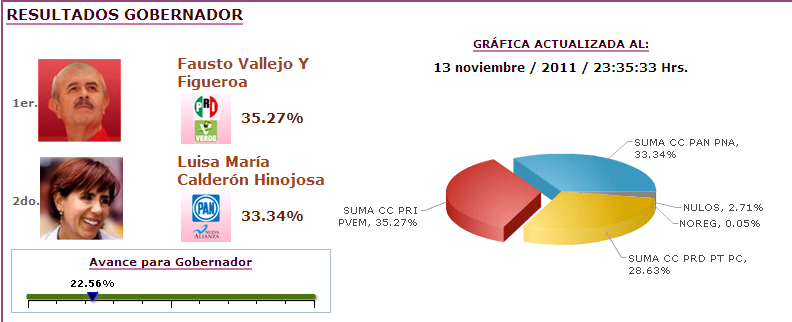
With 22.56% of the votes tallied, the Michoacán elections show a technical tie between the PRI and PAN candidates, with the PRD candidate not far behind. It’s almost a 30/30/30 split and the three of them have already declared themselves winners.

Just as the voting booths opened this morning, some of the parties involved were already screaming about fraud taking place. More than 40 arrests have occurred in relation to attempts to manipulate voting processes, plus we have the fact that the electoral authority’s website was hacked while the elections were taking place. The IEM declared that the vote tallying system was not affected by the attack but these days, can you really trust them?

Here’s what’s gonna happen in the next hours:

100% of the votes will be counted and they will show a very very close race between the PRI and PAN candidates, probably with the PRI candidate as the first place, with less than 2% of a difference. The PRD candidate will have lagged behind but that won’t stop him from claiming victory.

All three candidates will maintain that they won and none of them will back down. They will then start declaring that certain booths were compromised so a bunch of them will be cancelled out. Even after that, we will still have no clear winner. This will end up in the courts and in all likelihood, the PRI will be declared winner. PRD will take to the streets screaming “fraud” once more and either Ebrard or López Obrador will use this case as leverage for the presidential race. They will hold that PRI stole the election and use this to tarnish the PRI’s already dirty image. Cocoa Calderón will fade into the background. 

It’s going to be quite a mess and it’s never going to be about the will of the Michoacanos.

Viva México.

Hacking for Freedom in Mexico: The Anonymous Movement #OpCartel

Standard

Here is a link to my latest article on AQBlog, titled “Hacking for freedom in Mexico: The Anonymous Movement” , published on Nov 4th, 2011. Please feel free to visit and comment.

Here is a verbatim copy of it in case you prefer to read it on my personal blog, though I recommend actually going to the site because of additional content, other blogger’s articles, etc.

PS. I posted an earlier version of this article on this blog yesterday. This is the up to date version given the fact that the story has evolved since I first wrote  it.

—–

On November 5, if the threats posted are real, Mexico could be witness to a new kind of civil resistance to the status quo and political system. Mexican and international members of the hacker group known as Anonymous, have published through different media (interviews to news papers, YouTube videos and twitter accounts) that although #OpCartel has been cancelled, a former member of the network and independent journalist will divulge information of ties between specific high-level government officials and the criminal organization Los Zetas, initially in the state of Veracruz but potentially in all of the country.

Anonymous officially backed down from unleashing #OpCartel allegedly due to the fact that their kidnapped member was released by the Zetas, but also due to threats from this group of a tenfold retaliation against the families of members in the hacker organization. Barrett Brown’s (@BarrettBrownLOL) decision to reveal information on the drug cartel on his own volition might just be a way to protect the Mexican Anonymous members while continuing to carry out the hacker’s intended agenda. If the campaign is successful, the actions initiated by Anonymous and supposedly continued solely by Brown, could lead to a nationwide political scandal at incisively interesting pre-election times for the country.

In recent articles published here, I’ve posited that regardless of the people in power, Mexico’s core problems are systemic. The political structure in place not only allows, but even invites corrupt practices to take place. Collusion between politicians and criminals is widely suspected. Mexicans know the story all too well and the constant element present in each of the challenges we face as a country is lack of accountability and immense impunity, which is now being challenged by the actions of a rogue hacker group who could open up Pandora’s box and shed some light on the subject.

It would be myopic and pessimistic to say that Mexico’s democracy has not progressed in the last 80 years but in some ways, the country has also taken steps back. Elections have become more free and fair and transparency is advancing to a certain point, but law enforcement has not been able to follow through accordingly. Civil liberties have been strengthened officially but given the state of violence and insecurity in many regions of the country, society would likely tell you that today they feel less free.

Freedom of speech and of the press might be the clearest example of this duality between progress and retreat. During the PRI (Partido de la Revolución Institucional) monopoly of power, press was controlled by limiting or allowing newspapers access to a basic raw material: paper. If the government didn’t like what you wrote, they would simply not sell you the paper to print it. While those days are over, there are now new tactics to attempt to constrict free press: violence against journalists.

According to a recent assessment by the UN and the OAS Mexico is the fifth most dangerous country in the world for journalists. Other organizations and institutions have ranked it as the most dangerous globally. In 2011, 13 journalists have been killed in the country and while investigations have not yet concluded, there is a clear link between these killings and drug cartels/organized crime. Today, newspapers are officially free to publish just about anything, but it is also evident that there are powerful forces at play which put forth new tactics to silence the media. For this reason, cyber activism and the use of new media to overcome violent censorship thru blogs and social networks have recently flourished in the country. Though not unscathed by criminal intent to silence them as well, these informal media allow culprits to enjoy protection through a certain level on anonymity.

Operation Cartel was reportedly born as a means to pressure a drug cartel in Veracruz to release a member of the Anonymous network who had been abducted. But it quickly evolved and grew into something much bigger than the fate of one of its members. On November 2, a message was broadcast across the network saying that they would cancel Operation Cartel as a way to protect the individual whose life was being threatened by the cartel.

But according to a Brown, a former spokesperson, “shortly thereafter, the assembled people held a vote and decided nonetheless to go ahead with the operation.” This is why, even after the release of the victim, Brown plans to move forward on the canceled operation. Both a flaw and virtue, the fact that Anonymous does not have a clear power structure allows for individuals and smaller cells in the network to act independently whilst maintaining that their efforts are coordinated.

In this regard, cyberactivism becomes a strange new force to be reckoned with and as both Egypt and Libya have shown. It is a catalyst for widespread outcry; however, it is a weak means to organize a movement that can actually follow through after reaching its objective. Thus, the fallout of Operation Cartel could potentially be immensely disruptive and lead to political crisis, but I am unsure that it could lead to a clear effort to fix the system. Members from Anonymous in Mexico have even stated that they are non-political, though they do say they want to create a social conscience. Does Anonymous have the moral and role legitimacy to do this? Are they the new voice of the global people? Does it matter if they are or not?

A bigger question to pose would be if Anonymous’ Operations will always strive for social justice (defined by whom?) and with the loose level of allegiance that a network can create as opposed to a formal organization, what would stop cyber activists from straying away of the group and chasing a different agenda?

For now, Mexico anxiously waits to see what Barret Brown will do. Many champion this effort as a new and creative means to tackle a problem that for too long has been a tragedy of the commons in Mexico. As the tagline from the movie that inspired Anonymous goes, we are about to see if Mexico will remember the 5th of November.

*Arjan Shahani is a contributing blogger to AmericasQuarterly.org. He lives in Monterrey, Mexico, and is an MBA graduate from Thunderbird University and Tecnológico de Monterrey and a member of the International Advisory Board of Global Majority—an international non-profit organization dedicated to the promotion of non-violent conflict resolution.

History occurs faster than publishing… #OpCartel

Standard

I was going to get a story on Anonymous’ #OpCartel published at AQBlog, most likely tomorrow, but I just learned that the hacker group’s operation has been cancelled due to the fact that the drug cartel released the kidnapped hacker. An independent journalist abroad has stated that he will carry out the operation but independently from Anonymous, as the group has been threatened by the cartel with dire repercussions and retaliation if they follow through on their threats to publish the names of government officials linked to organized crime…

Anyways, I will probably end up editing the story in order to update it before it goes online at the Americas Quarterly blog but I wanted to share with you the original story, as it was written and intended. I’ll let you know when the updated story also goes online.

I hope you like it:
Hacking for freedom in Mexico

 On November 5th, if the threats posted are real, Mexico could be witness to a new kind of civil resistance to the status quo and political system. Mexican and international members of the hacker group known as Anonymous, have published through different media (interviews to news papers, YouTube videos and twitter accounts) that on said date they will unleash “Operation Cartel” informing the world of ties between specific high-level government officials and the criminal organization Los Zetas, initially in the state of Veracruz but potentially in all of the country. If Anonymous is successful, their actions could lead to a nation-wide political scandal at incisively interesting pre-election times for the country.

 In recent articles published here, I’ve posited that regardless of the people in power, Mexico’s core problems are systemic. The political structure in place not only allows, but even invites corrupt practices to take place. Collusion between politicians and criminals is widely suspected. Mexicans know the story all too well and the constant element present in each of the challenges we face as a country is lack of accountability and immense impunity, which is now being challenged by a rogue hacker group who threatens to open up Pandora’s box and shed some light on the subject.

 It would be myopic and pessimistic to say that Mexico’s democracy has not progressed in the last 80 years but in some ways, the country has also taken steps back. Elections have become more free and fair and transparency is advancing to a certain point, but law enforcement has not been able to follow through accordingly. Civil liberties have been strengthened officially but given the state of violence and insecurity in many regions of the country, society would likely tell you that today they feel less free. 

 Freedom of speech and of the press might be the clearest example of this duality between progress and retreat. During the PRI (Partido de la Revolución Institucional) monopoly of power, press was controlled by limiting or allowing newspapers access to a basic raw material: paper. If the government didn’t like what you wrote, they would simply not sell you the paper to print it on. While those days are over, there are now new tactics to attempt to constrict free press: violence against journalists.

 According to a recent assessment by the UN and the OAS Mexico is the fifth most dangerous country in the world for journalists. Other organizations and institutions have ranked it as the most dangerous world-wide. In 2011, 13 journalists have been killed in the country and while investigations have not yet concluded, there is a clear link between these killings and drug cartels/organized crime. Today, newspapers are officially free to publish just about anything, but it is also evident that there are powerful forces at play which put forth new tactics to silence the media. For this reason, cyber activism and the use of new media to overcome violent censorship thru blogs and social networks have recently flourished in the country. Though not unscathed by criminal intent to silence them as well, these informal media allow culprits to enjoy protection through a certain level on anonymity.   

 Operation Cartel was reportedly born as a means to pressure a drug cartel in Veracruz to release a member of the Anonymous network which had been abducted, but quickly evolved and grew into something much bigger than the fate of one of its members. On November 2nd, a message was broadcast across the network saying that they would cancel Operation Cartel as a way to protect the individual whose life was being threatened by the cartel but according to a former spokesperson, “shortly thereafter, the assembled people held a vote and decided nonethless to go ahead with the operation.” Both a flaw and virtue, the fact that Anonymous does not have a clear power structure allows for individuals and smaller cells in the network to act independently whilst maintaining that their efforts are coordinated.

 In this regard, cyberactivism becomes a strange new force to be reckoned with and as both Egypt and Libya have shown, a catalyst for widespread outcry though a weak means to organize a movement which can follow through after reaching their objective. Thus, Operation Cartel could potentially be immensely disruptive and lead to political crisis but I am unsure that it could lead to a clear effort to fix the system.  Members from Anonymous in Mexico have even stated that they are non-political, though they do say they want to create a social conscience.  The question is, does Anonymous have the role legitimacy to do this? Are they the new voice of the global people? Does it matter if they are or not?

 A bigger question to pose would be if Anonymous’ Operations will always strive for social justice (defined by whom?) and with the loose level of allegiance that a network can create as opposed to a formal organization, what would stop cyber activists from straying away of the group and chasing a different agenda?

 For now, Mexico anxiously waits to see the development of Operation Cartel. Many champion this effort as a new and creative means to tackle a problem that for too long has been a tragedy of the commons in Mexico. As the tagline from the movie that inspired Anonymous goes, we are about to see if Mexico will remember, remember the 5th of November.